
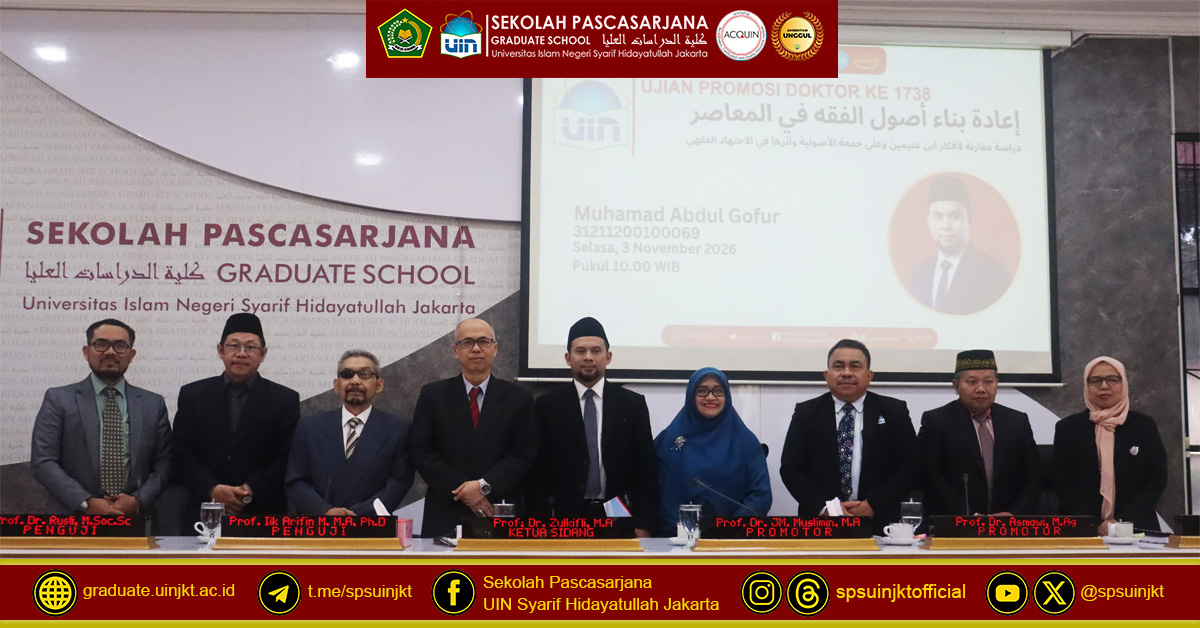
Muhamad Abdul Gofur's Doctoral Promotion Exam, Reconstruction of Contemporary Ushul Fiqh: The Thoughts of Ibn Uthaimin and Ali Jum'ah
Auditorium Prof. Dr. Suwito, MA SPs UIN Jakarta, SP NEWS – The Graduate School (SPs) of UIN Syarif Hidayatullah Jakarta held the 1738th Doctoral Promotion Exam in the Auditorium Room of Prof. Dr. Suwito, MA Graduate School on Tuesday, November 3, 2026 with promovendus Muhamad Abdul Gofur.
Gofur is a student of the Doctoral program in Islamic Studies with a concentration in Sharia. His dissertation is titled "إعادة بناء أصول الفقه المعاصر: دراسة مقارنة لأفكار ابن عثيمين وعلي جمعة الأصولية وأثرها في الاجتهاد الفقهي". This study highlights the comparison between two great contemporary scholars, namely Ibn Uthaimin, who is known for his textual approach, and 'Ali Jum'ah who combines texts with social realities.
So far, the study of the thoughts of the two figures has often been carried out separately and partially. Most researchers only look at one of them independently, or compare the products of fiqh without touching the epistemological roots, methodological, and sociological backgrounds that shape their legal views. This synergistic academic gap is the main starting point in this dissertation.
Specifically, this research has four main comprehensive objectives. First, to dismantle the epistemological and methodological foundations of the two figures while looking at the influence of the surrounding environment on the formation of their ideas. Second, to describe the differences in the way of perspective between the two in treating the semantics of religious texts and their implications for ijtihad fiqh. Third, to map the use of disputed ijtihadi postulates in producing contemporary law. Fourth, to offer an integrative model of Ushul Fiqh that is able to bridge the gap between the autocracy of the text and the need for the renewal of the times.
In order to achieve this goal, the promovendus uses descriptive-analytical and comparative methods. The comparative approach of Ushul Fiqh in the style of Ibn Rushd is applied to dissect the internal logic and dialectic between the two figures. Not only that, this research also operationalizes the sociological approach of Karl Mannheim's knowledge to interpret how social structures and existential living spaces shape their ushuliyah choices.
The results of this study found that there are very fundamental differences in epistemological structure between the two. Ibn Uthaimin's thought is characterized by objective monism that prioritizes the literal meaning of the text over the consideration of maqasid. On the other hand, Ali Jum'ah's thought is characterized by epistemological pluralism, methodological flexibility, and places maqasid al-sharia as the main interpretive consideration when the text feels narrow in the face of new problems.
The next finding confirms that the difference in fiqh products between these two scholars is firmly rooted in the differences in istinbat methods and their existential environment. The difference in the social atmosphere between Saudi Arabia, which tends to be conservative, and Egypt, which is very pluralistic, has proven to be a major contribution in shaping their respective legal consciousness.
From these findings, this dissertation succeeded in formulating a new methodological model consisting of five systematic stages, namely textual verification, reality analysis, the use of ijtihadi postulates, tarjih maqasidi, and the formulation of fatwas accompanied by periodic evaluation. This model is designed to ensure the creation of a harmonious balance between the decrees of sacred texts and the flexibility of their application in the field.
The main novelty of this research lies in the formulation of an integrative Ushul Fiqh model that successfully fuses the textual approach of Ibn Uthaimin and the contextual maqasidi of Ali Jum'ah. The presence of Karl Mannheim's sociological framework also enriches the treasure of research by successfully revealing transparently how the social environment also frames the scientific reasoning of a scholar.
Practically, the integrative model offered in this dissertation is expected to be a valuable reference for fatwa institutions, academics in the field of Ushul Fiqh, as well as materials for the development of Islamic studies curricula in various universities. Through this holistic approach, UIN Jakarta reaffirms its role as a center of academic excellence that gives birth to concrete solutions for the dynamics of Islamic law today.
Gofur successfully defended his dissertation under the guidance of Prof. Dr. JM Muslimin, MA and Prof. Dr. Asmawi, M.Ag, and was tested in front of a board of examiners consisting of Prof. Dr. Zulkifli, MA, Prof. Dr. JM Muslimin, MA, Prof. Dr. Asmawi, M.Ag, Prof. Dr. Rusli, S.Ag, M.Soc.Sc, Prof. Dr. Iik Arifin Mansurnoor, MA, Dr. Imam Sujoko, MA.
After paying attention to the writing of the dissertation, the comments of the examiner team and the answers of the examiners, the examiner team determined that Muhamad Abdul Gofur graduated with the title of Very Satisfactory. Muhamad Abdul Gofur is the 1738th Doctor in the field of Islamic Studies, the doctoral program of the Graduate School of UIN Syarif Hidayatullah Jakarta. (Jay A)