
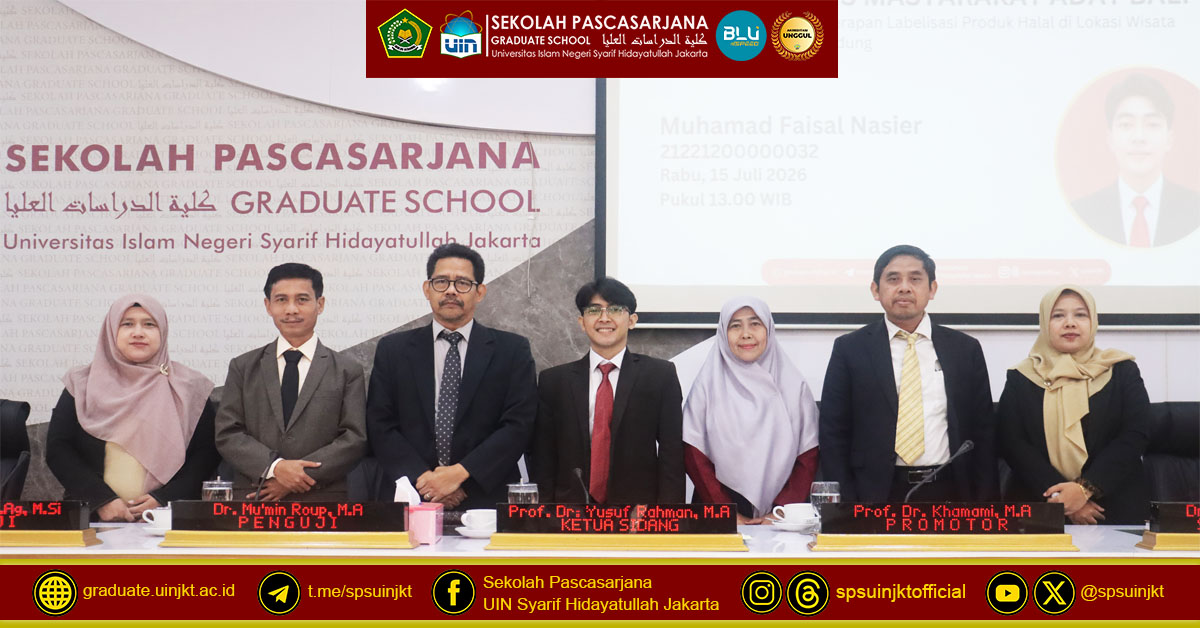
Muhamad Faisal Nasier's Thesis Test, Balinese Indigenous Peoples' Response to the Implementation of Halal Product Labeling
Auditorium of Prof. Dr. Suwito, MA SPs UIN Jakarta, SPs NEWS - The Graduate School (SPs) of UIN Syarif Hidayatullah Jakarta held the 2818th Thesis Exam at the SPs Theater Room of UIN Jakarta on Wednesday, July 15, 2026 with candidate Muhamad Faisal Nasier.
Faisal is a student of the Master of Islamic Studies program with a concentration in Religion and Law. His thesis is entitled "Response of Balinese Indigenous Peoples to the Implementation of Halal Product Labeling in Badung Regency Tourist Sites".
This research focuses on how local communities in one of the busiest tourist destinations in Bali respond to the halal certification regulations that have been launched nationally.
Using a qualitative approach of field studies, Faisal elaborated in-depth interview techniques, direct observation, and comprehensive document analysis. In order to obtain objective and balanced data, he involved various key parties in the field, ranging from traditional leaders, religious leaders, local business actors, to representatives from local governments.
Faisal's findings show a very diverse spectrum of responses from indigenous Balinese people, ranging from open acceptance to rejection. Tensions at the beginning arose due to concerns that halal labeling carries certain religious identities that have the potential to marginalize traditional Hindu products, especially pig-based culinary and a means of supporting religious rituals.
Interestingly, this resistance does not lead to a dead-end conflict but opens up a dynamic negotiation space. Through an ongoing process of cross-sectoral dialogue, tensions are slowly easing along with the strong values of pluralism and tolerance that have long been rooted in the daily lives of the Balinese people.
Educational steps from the Halal Product Assurance Agency (BPJPH) also play a key role in reducing residents' anxiety. The official explanation that halal certification is voluntary for non-Muslim business actors and does not target religious ritual products at all helps the public understand that this policy is functional for the sake of the tourism market, not ideological.
In this dynamic, the local government appears as a reliable mediator at the forefront. Local governments have succeeded in guarding national legal obligations to continue to run hand in hand without harming the nobility of local cultural values, creating a harmonious synthesis between state law and customary law (awig-awig).
Faisal's thesis offers a fresh perspective that is different from the previous study of JM Muslimin (2020), which analyzed the Halal Product Assurance Law purely from the lens of Muslim consumer protection. While these regulations are often suspected of being biased or discriminatory against minority groups, Faisal's research critically proves that these concerns can be dismissed through inclusive implementation in the field.
This research also strengthens the findings of Rakhman Priyatmoko and Addin Maulana (2022) regarding the penetration of the halal market which is now penetrating the Bali tourism sector. Nevertheless, Faisal reminded that the discourse of "halal tourism" still leaves pros and cons in various regions with a majority of non-Muslims such as Labuan Bajo, Lake Toba, and Toraja who are worried about the fading of their original cultural image.
In the end, this thesis concludes an important message for policymakers: the success of national regulation depends heavily on sensitivity to local wisdom. Participatory dialogue and the presence of the state as a fair mediator are the main keys in bridging economic interests, religious beliefs, and the preservation of the archipelago's cultural identity.
Faisal successfully defended his thesis under the guidance of Prof. Dr. Khamami, MA, and was tested in front of a board of examiners consisting of Prof. Dr. Yusuf Rahman, MA, Prof. Dr. Khamami, MA, Dr. Mu'min Roup, MA, Dr. Masyrofah, M.Si.
After paying attention to the thesis writing, the comments of the examiner team and the candidate's answers, the examiner team determined that Muhamad Faisal Nasier graduated with the predicate of Very Satisfactory. Muhamad Faisal Nasier is the 2818th Master in the field of Islamic Studies, in the Master's program of the Graduate School of UIN Syarif Hidayatullah Jakarta. (Jay A)