
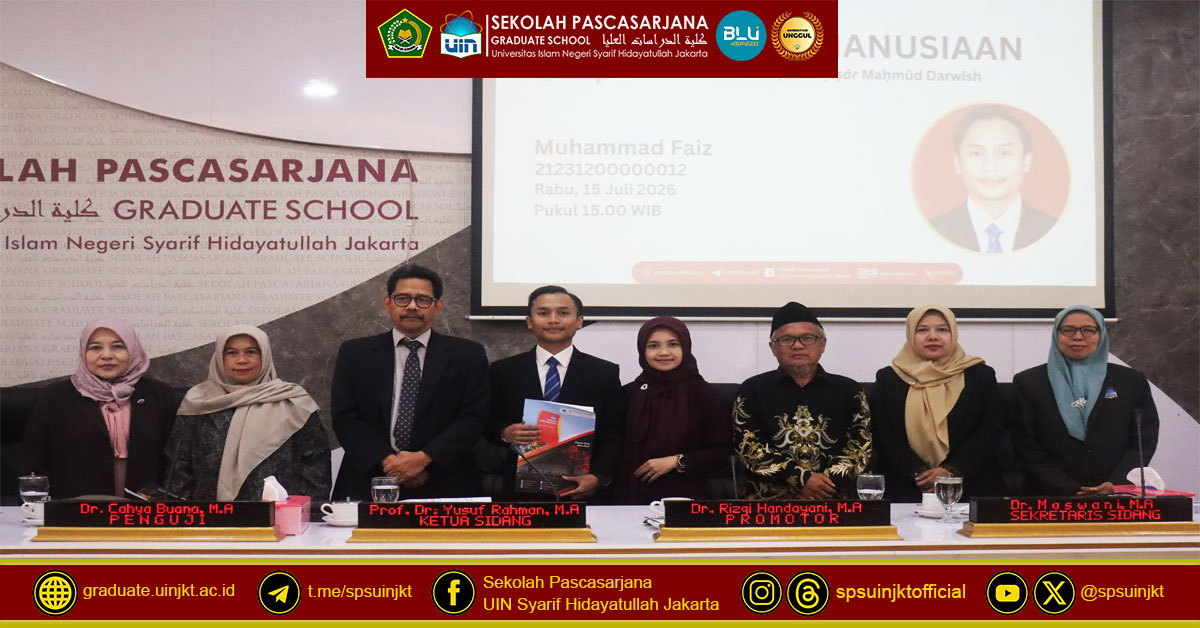
Muhammad Faiz's Thesis Test, The Tragedy of Humanity in the Poem of Resistance Ḥālah Ḥiṣār Maḥmūd Darwīsh
Auditorium of Prof. Dr. Suwito, MA SPs UIN Jakarta, SPs NEWS - The Graduate School (SPs) of UIN Syarif Hidayatullah Jakarta held the 2819th Thesis Exam at the Auditorium Room of Prof. Dr. Suwito, MA SPs UIN Jakarta on Wednesday, July 15, 2026 with candidate Muhammad Faiz.
Faiz is a student of the Master of Islamic Studies program with a concentration in Arabic Language and Literature. His thesis is entitled "The Tragedy of Humanity in the Poetry of Resistance Ḥālah Ḥiṣār Maḥmūd Darwīsh".
This research departs from academic anxiety to dissect how literary works are able to capture the dark reality of oppression. In particular, this thesis examines the social function of the poem as a form of cultural resistance of the Palestinian people to Israeli colonialism.
Using the library research method with a qualitative-descriptive approach, Faisal uses the original text of the poem Ḥālah Ḥiṣār by the legendary poet Maḥmūd Darwīsh as primary data. To strengthen his analysis, he combined it with a variety of relevant supporting academic literature. This step was taken to ensure that the reading of Darwīsh's work had a solid theoretical foundation.
The data collection process in this research was carried out diligently through the Read, Listen, and Record (BSC) technique. Faisal reads the text of the poem intensively and repeatedly to capture every implied poetic essence. He listened carefully to the existing aesthetic elements, then recorded crucial data that were directly related to human tragedy, Islamic humanism, and the social function of literature.
The analysis knife used in this thesis is also fairly comprehensive. Faisal dissects the work textually and contextually using a combination of Ian Watt's Theory of Literary Sociology, the concept of Adab al-Muqāwamah (resistance literature), and the perspective of Islamic Humanism. As a result, this study succeeded in proving that the poem Ḥālah Ḥiṣār is not just a lament for suffering, but a profound moral reflection.
Thethematically, this thesis reveals how Darwīsh's poetry deftly represents the loss of identity, social alienation, and existential tensions of human beings living under siege. Interestingly, behind the dark portrait, there are also the values of courage, patience, and universal compassion. These values are what Faisal underlines as a real manifestation of Islamic Humanism.
Through his analysis, Faisal emphasized that Darwīsh did not voice resistance through passionate political slogans. Instead, the poet transforms the meaning of physical suffering into a high moral and spiritual consciousness. This humanist approach is what makes the message of resistance in the poem feel so universal and touches the hearts of the reader.
Viewed from the social and cultural dimensions, this study positions the poem Ḥālah Ḥiṣār as a very effective medium of intellectual resistance. This literary work has proven to be able to foster cross-border solidarity and build collective awareness among oppressed people. More than that, this poem exists as a space for loud criticism of all forms of global injustice and dehumanization.
Faisal argues that although poetry is often underestimated as an aesthetic work full of metaphors and wild imagination, its function in the real world is much greater. The resistance poetry of Maḥmūd Darwīsh is an active social medium and a real cultural force. In it, the aspects of aesthetics (beauty), ethics (morality), and spirituality are integrated into the weapons of cultural diplomacy adopted by society.
Previous research on Ḥālah Ḥiṣār was dominated by linguistic, pragmatic, stylistic, and intertextuality studies, Faisal offers novelty through the lens of Literary Sociology and Islamic Humanism. These findings confirm that resistance literature does not stop as an art display, but rather an important pillar in caring for human dignity.
Faiz successfully defended his thesis under the guidance of Dr. Rizqi Handayani, MA, and was tested in front of a board of examiners consisting of Prof. Dr. Yusuf Rahman, MA, Dr. Rizqi Handayani, MA, Yeni Ratna Yuningsih, MA, Ph.D, Dr. Cahya Buana, MA.
After paying attention to the thesis writing, the comments of the examiner team and the candidate's answers, the examiner team determined that Muhammad Faiz graduated with the title of Very Satisfactory. Muhammad Faiz is the 2819th Master in the field of Islamic Studies, in the Master's program of the Graduate School of UIN Syarif Hidayatullah Jakarta. (Jay A)