
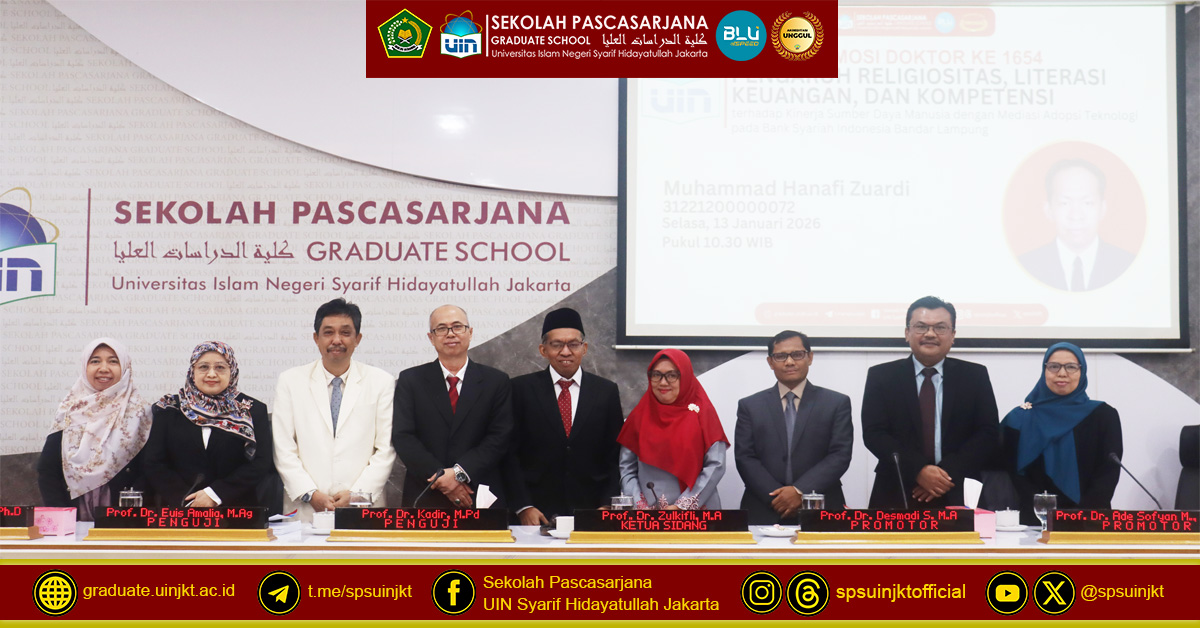
Muhammad Hanafi Zuardi Doctoral Promotion Exam: The Influence of Religiosity, Financial Literacy, and Competence on Human Resource Performance
Auditorium of Prof. Dr. Suwito, MA SPs UIN Jakarta, SPs NEWS - The Graduate School (SPs) of UIN Syarif Hidayatullah Jakarta held the 1654th Doctoral Promotion Exam in the Auditorium Room of Prof. Dr. Suwito, MA on Tuesday, January 13, 2026 with promovendus Muhammad Hanafi Zuardi.
Hanafi is a student of the Doctoral program in Islamic Studies with a concentration in Sharia Banking and Finance Management. His dissertation is entitled "The Influence of Religiosity, Financial Literacy, and Competence on Human Resource Performance by Mediating Technology Adoption at Bank Syariah Indonesia Bandar Lampung".
This research departs from the urgency to understand what actually drives employee effectiveness in the midst of modern banking competition that is increasingly digital but still tied to spiritual values.
Using a mixed methods approach with a sequential explanatory design, Hanafi combines the power of quantitative data and the depth of qualitative analysis. He involved 86 employees of Bank Syariah Indonesia (BSI) Bandar Lampung as questionnaire respondents, and strengthened his findings through in-depth interviews with five key informants to capture the reality on the ground in its entirety.
The results of data analysis using PLS-SEM revealed interesting findings: religiosity, financial literacy, and technology adoption have been proven to have a direct and significant effect on human resource performance. This confirms that the combination of moral integrity, financial understanding, and mastery of work tools is the main key to employee productivity in the Islamic banking environment.
However, there was a surprising anomaly in this research, where competency variables were found to have no significant direct effect on performance. This phenomenon indicates that the possession of technical skills alone does not guarantee maximum performance if it is not accompanied by strong religious values and a willingness to adapt to the latest technology.
In the indirect influence test, it was revealed that religiosity does not stand alone in spurring performance. The role of religiosity as a driver of performance will be more optimal when mediated by financial literacy and technology adoption. In contrast, the mediation pathway through competence and chain mediation did not show significant results in this study.
Qualitatively, Hanafi emphasized that religiosity serves as the foundation of fundamental values and work ethics. Meanwhile, financial literacy acts as a mechanism for internalizing Islamic economic values, and technology adoption is present as a vital instrument that increases the efficiency and effectiveness of the work of banking practitioners.
These findings reinforce theories from Hassi and Balambo (2018) and Qudah et al. (2023). The results of this research agree with the view that Islamic values play a crucial role in shaping superior work behavior. Faith is not just a private affair, but a spiritual capital that transforms into professionalism in the office space.
In line with the thinking of Kamal Badar et al. (2024), this study positions Islamic work ethics as an "intangible asset". These values are internalized in the work relationships and organizational behavior, creating a more harmonious and results-oriented work climate.
On the other hand, Hanafi's research refutes the studies of Andreou and Anyfantaki (2022) and Suryadi et al. (2022) which tend to favor technical factors. If previous studies called competence and technology more dominant, this research actually proves that in Islamic banks, religious values remain the main anchor that determines the success of performance.
This dissertation provides real practical implications for the management of Islamic banking. Strengthening human resources should not only focus on technical training, but must integrate the development of religiosity and Islamic financial literacy wrapped in the use of ethics-based technology, in order to realize a resilient and dignified financial industry.
Muhammad Hanafi Zuardi successfully defended his dissertation under the guidance of Prof. Dr. Desmadi Saharuddin, MA; Prof. Dr. Ade Sofyan Mulazid, S.Ag, MH, and tested in front of a board of examiners consisting of Prof. Dr. Zulkifli, MA; Prof. Dr. Desmadi Saharuddin, MA; Prof. Dr. Ade Sofyan Mulazid, S.Ag, MH; Prof. Dr. Euis Amalia, M.Ag; Prof. Nur Hidayah, S.Ag, SE, MA, MA, Ph.D; Prof. Dr. Kadir, M.Pd.
After paying attention to the writing of the dissertation, the comments of the examiner team and the promovenda's answers, the examiner team determined that Muhammad Hanafi Zuardi graduated with the title of Very Satisfactory. Muhammad Hanafi Zuardi is the 1654th Doctor in the field of Islamic Studies, in the doctoral program of the Graduate School of UIN Syarif Hidayatullah Jakarta. (JA)