
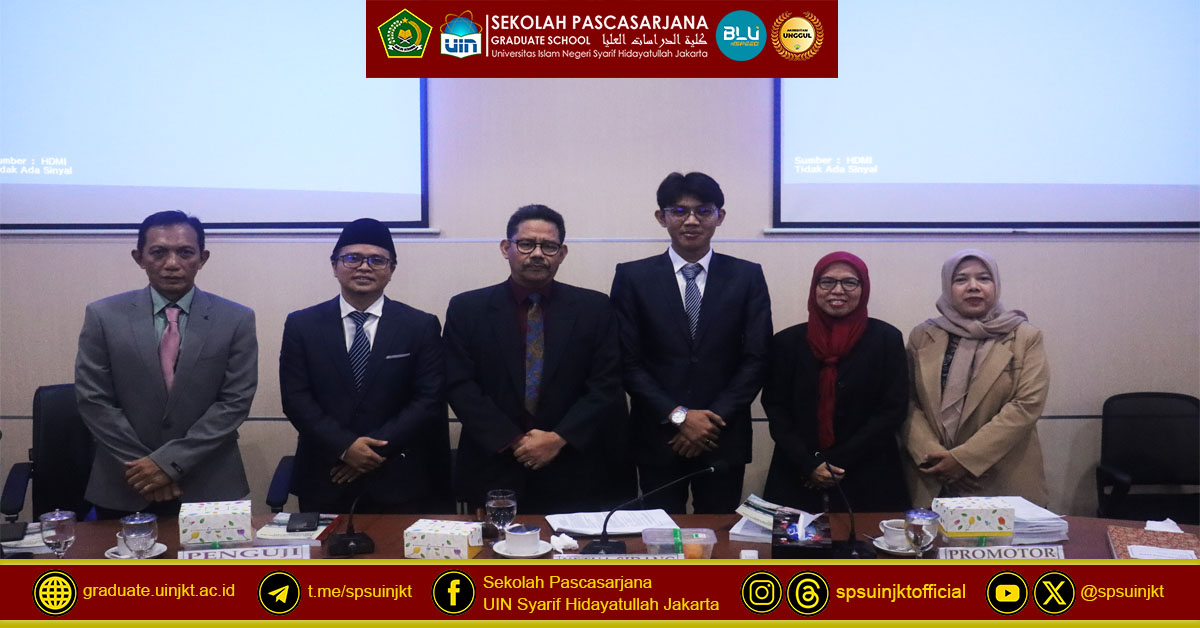
Muhammad Hirzy Haikal Fasha Thesis Exam, Arabic Language Learning Model Based on Love Curriculum at MAN 4 Jakarta
Auditorium of Prof. Dr. Suwito, MA SPs UIN Jakarta, SPs NEWS - The Graduate School (SPs) of UIN Syarif Hidayatullah Jakarta held the 2829th Thesis Exam at the SPs Theater Room of UIN Jakarta on Wednesday, July 29, 2026 with candidate Muhammad Hirzy Haikal Fasha.
Hirzy is a student of the Master of Islamic Studies program with a concentration in Arabic Language Education. His thesis is entitled "Arabic Language Learning Model Based on the Love Curriculum at MAN 4 Jakarta".
The research was raised to comprehensively analyze how the implementation of Arabic language learning based on the Love-Based Curriculum (KBC) is implemented in the MAN 4 Jakarta environment. In addition, this study specifically examines the real contribution of the approach model to strengthening the affective domain of students in the daily learning process.
In dissecting this phenomenon, the research uses a qualitative method of case studies by integrating a number of multidisciplinary theoretical frameworks. Carl Rogers' humanistic educational approach, Vygotsky's sociocultural theory, Stephen Krashen's affective filter hypothesis , and the taxonomy of the affective domain of Krathwohl, Bloom, and Masia are combined to provide a solid foundation for analysis.
Through this conceptual framework, learning Arabic is read not only as a linguistic transfer process, but also as a complete affective experience. The learning environment is designed to be safe, empathetic, dialogical, collaborative, and low anxiety so that it can support the internalization of positive values in students.
The collection of research data was carried out thoroughly through direct observation in the field and semi-structured interviews with two Arabic teachers and students across programs ranging from classes X–XI Regular, Cambridge, to Dormitory. The researcher also analyzed various supporting documents such as curriculum, teaching modules, teaching materials, evaluation instruments, and activity archives.
After going through the stages of data analysis which included condensation, presentation, and drawing conclusions, the results showed that KBC at MAN 4 Jakarta was integrated in a cohesive manner in four mahārah (language skills). Learning is packaged based on experience (experiential learning) by applying the principles of mindful, meaningful, and joyful learning, and supported by creative activities with a design thinking and design for change approach.
This research strongly argues that the KBC model succeeds in directing the mastery of language skills while fostering manners, empathy, polite communication, and love of knowledge. In addition, this model has been proven to be able to increase religious awareness, socio-environmental concern, positive discipline, and students' courage in communicating using Arabic.
The success of this contribution is supported by several key factors, including the role model and professional competence of teachers, a religious-humanist madrasah culture, contextual learning design, and sustainable institutional support. Nevertheless, this study still notes the existence of classical obstacles for students, especially in mastering qawā'id (grammar) and mufradāt (vocabulary).
Comparatively, the results of this research are in line with and strengthen the findings of previous researchers such as Zilfania, Heni, Aniqa, and Taslim regarding the great potential of KBC in strengthening character and affectivity. However, the novelty of this research lies in its specific operationalization of Arabic subjects at the Madrasah Aliyah level. Different from Mukaromah and Aulia's study, this research proves that KBC at MAN 4 Jakarta has been concretely derived through learning design, supportive interaction, and constructive correction.
In closing, these findings confirm that the success of the Love-Based Curriculum is not enough to rely solely on normative values. As emphasized in the view of Muhammad Zikran Adam (2024), strengthening values and communicative approaches must be balanced with mastery of linguistic materials. Thus, KBC has proven to be an integrative pedagogical model that effectively combines linguistic competence and affective reinforcement of students in a sustainable manner.
Hirzy successfully defended his thesis under the guidance of Dr. Maswani, MA, and was tested in front of a board of examiners consisting of Prof. Dr. Yusuf Rahman, MA, Dr. Maswani, MA, Dr. Zainal Muttaqin, MA, Dr. Achmad Fudhaili, M.Pd.
After paying attention to the thesis writing, the comments of the examiner team and the candidate's answers, the examiner team determined that Hirzy graduated with the predicate of Very Satisfactory. Muhammad Hirzy Haikal Fasha is the 2829th Master in the field of Islamic Studies, in the Master's program of the Graduate School of UIN Syarif Hidayatullah Jakarta. (Jay A)