
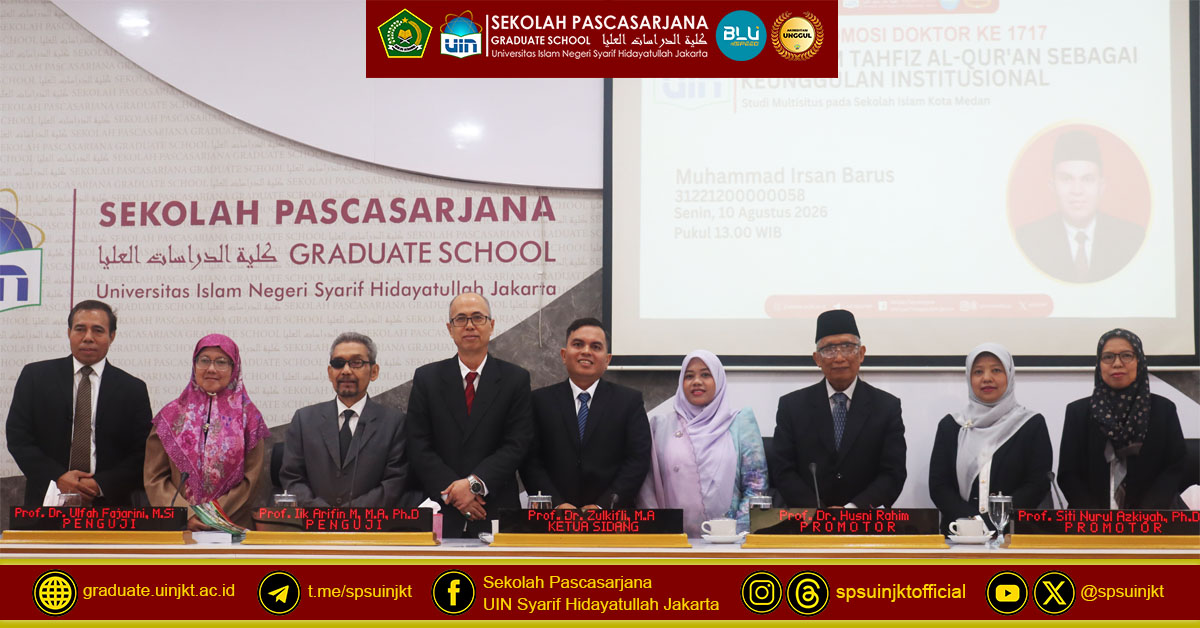
Muhammad Irsan Barus Doctoral Promotion Exam, Tahfiz Al-Qur'an Program as Institutional Excellence
Auditorium Prof. Dr. Suwito, MA SPs UIN Jakarta, SPs NEWS – The Graduate School (SPs) of UIN Syarif Hidayatullah Jakarta held the 1717th Doctoral Promotion Exam in the Auditorium Room of Prof. Dr. Suwito, MA Graduate School on Monday, August 10, 2026 with promovendus Muhammad Irsan Barus.
Irsan is a student of the Doctoral program in Islamic Studies with a concentration in Islamic Education. His dissertation is entitled "Tahfiz Al-Qur'an Program as Institutional Excellence: Multisite Study at Islamic Schools of Medan City".
This research is designed in depth to dissect how the tahfiz Al-Qur'an program can be transformed into differentiation and institutional excellence in seven Islamic schools at the junior high school (SMP/MTs) in Medan City. Using a qualitative approach with a multisite study design, this study comprehensively captures the strategies of educational institutions in responding to modern society's needs for religious-based education.
Data collection procedures are strictly carried out through field observations, in-depth interviews, and analysis of official documents. To maintain the validity of the findings, the researcher applied a credibility and transferability test, which was followed by data processing through data condensation, data presentation, thematic categorization, conclusion drawn, and cross-site analysis.
From the results of empirical research, the first findings reveal that the policy of the Qur'an tahfiz program in these schools is rooted in a combination of theological, ideological, and regulatory foundations. This foundation is reflected in curriculum governance, human resource development, student management, evaluation systems, provision of facilities, and financing schemes, although the level of institutionalization varies from school to school.
The second finding shows diversity at the implementation level. The implementation of the tahfiz program has proven to be very dynamic and varies depending on the vision, special goals, variety of materials, learning methods applied, memorization evaluation systems, and communication strategies used by institutions to build school brand identity in the eyes of the public.
In the third finding, this study proves that the existence of the tahfiz program has a broad implicit impact. For students, this program has been proven to strengthen spiritual, social, academic, and psychological aspects. Meanwhile, for institutions, the success of the tahfiz program has a direct impact on strengthening religious identity, positive image, and improving the overall quality of schools.
Through an in-depth cross-site analysis, Irsan Barus categorized the implementation of the tahfiz Al-Qur'an program in Medan City into three main typologies. The first typology is symbolic, where tahfiz is positioned as a habituation-based religious identity with memorization targets that tend to be limited and flexible.
The second typology is integrative curricular, which is a model that integrates tahfiz programs into the formal learning system of schools to support the formation of character and culture of learning the Qur'an in a structured manner. Meanwhile, the third typology is accelerative, which places tahfiz as the main flagship program (flagship) with high memorization targets, intensive learning methods, and very strong institutional ecosystem support.
Theoretically, the findings across these seven schools are in line with the principles of Total Quality Management (TQM), especially in the aspects of stakeholder orientation and continuous quality improvement. Islamic schools in Medan are considered successful in responding to the expectations of parents, students, and the wider community through innovation and continuous improvement of the tahfiz program.
In addition, this research succeeded in expanding Hasan and Jaroni theses regarding the commodification and expression of piety in public spaces. This dissertation proves that tahfiz Al-Qur'an in formal schools, both boarding and non-boarding schools, is no longer just a symbol of external piety, but has been systematically institutionalized through policies, curriculum, and professional governance. This emphasizes that institutional excellence is born from the integration of policy directions, consistency of execution, and institutional commitment, not solely demanding high memorization targets.
Irsan successfully defended his dissertation under the guidance of Prof. Dr. Husni Rahim, Prof. Siti Nurul Azkiyah, M.Sc, Ph.D, and was tested in front of a board of examiners consisting of Prof. Dr. Zulkifli, MA, Prof. Dr. Husni Rahim, Prof. Siti Nurul Azkiyah, M.Sc, Ph.D, Prof. Dr. Ulfah Fajarini, M.Si, Prof. Dr. Alek, M.Pd, Prof. Dr. Iik Arifin Mansurnoor, MA.
After paying attention to the writing of the dissertation, the comments of the examiner team and the answers of the promovendus, the examiner team determined that Irsan graduated with the predicate of Very Satisfactory. Muhammad Irsan Barus is the 1717th Doctor in the field of Islamic Studies, doctoral program of the Graduate School of UIN Syarif Hidayatullah Jakarta. (Jay A)