
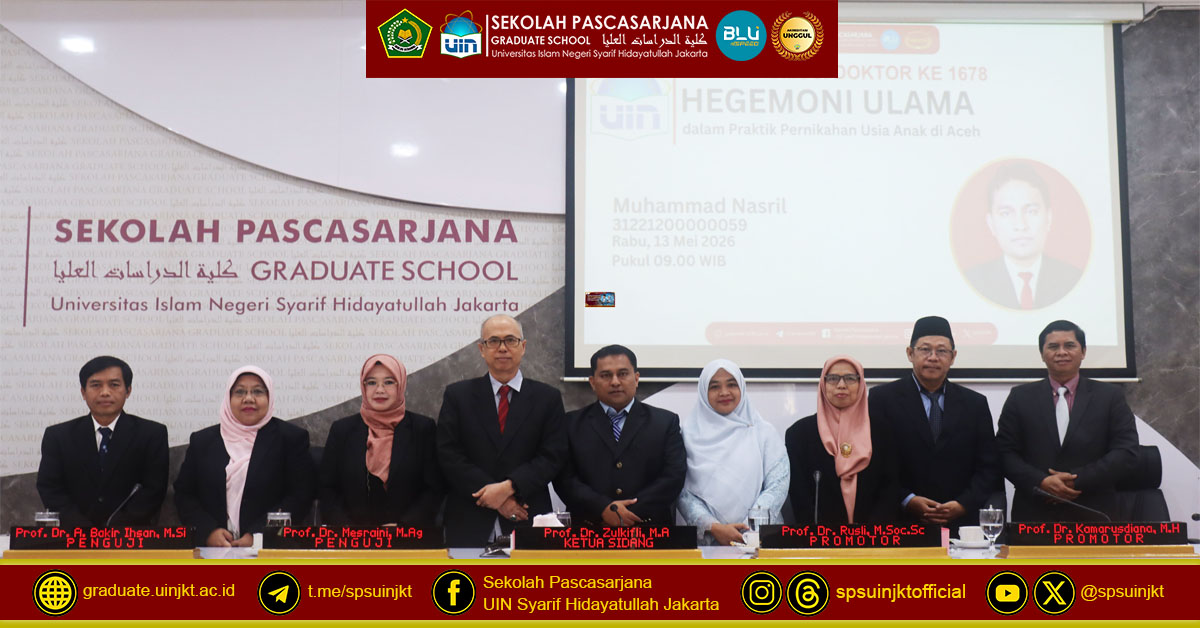
Muhammad Nasril's Doctoral Promotion Exam, Hegemony of Ulama in the Practice of Child Marriage in Aceh
Auditorium of Prof. Dr. Suwito, MA SPs UIN Jakarta, SPs NEWS – The Graduate School (SPs) of UIN Syarif Hidayatullah Jakarta held the 1678th Doctoral Promotion Exam in the Auditorium Room of Prof. Dr. Suwito, MA on Wednesday, May 13, 2026 with promovendus Muhammad Nasril.
Nasril is a student of the Doctoral program in Islamic Studies with a Concentration in Sharia. His dissertation is entitled "Hegemony of Ulama in the Practice of Child Marriage in Aceh".
This study captures the reality of how the marriage age limit is implemented in Aceh. Nasril highlighted that behind the statistics of early marriage, there is a strong influence of the views of scholars that permeates the joints of people's lives, forming a pattern that is not just a tradition, but the result of the construction of established religious thought.
The main focus of this research is to dissect the role of religion as the main instrument in perpetuating this practice. Nasril seeks to reveal how the hegemony of Acehnese clerics works systematically through religious legitimacy, social norms, and local cultural influences that are intertwined, so that child marriage is often considered a commonplace and even noble.
Using a qualitative approach with a case study strategy, Nasril conducted a direct sociological-juridical search to various districts and cities in Aceh. He not only fixated on the legal text, but also went into the field to capture the pulse of society and the reasons behind crucial decisions in the family.
The data in this study was collected through in-depth interviews with various stakeholders, ranging from charismatic scholars, women leaders, Ministry of Religion/KUA officials, to judges of the Sharia Court. The framework of Antonio Gramsci's theory of hegemony and Zaky Wahhaj's theory of child marriage are used as analytical knives.
The results of the study revealed the findings: the practice of child marriage in Aceh is a real manifestation of the dynamic hegemony of the ulama. The clerics here act as "organic intellectuals" who produce and reproduce religious discourse, making it the standard of truth in the social structure of Acehnese society.
Nasril explained that the construction of the marriage age limit in Aceh is not rigid, but is contextual and multidimensional. This is the fruit of a long negotiation between religious doctrine, the demands of social norms, a developing gender perspective, and the practical needs of society in dealing with the changing times.
One crucial point in these findings is the function of religion as a hegemonic instrument. Religion provides a strong moral legitimacy. In this context, the authority of the ulama is the determinant of which direction is considered in accordance with the sharia and which is considered deviant.
Interestingly, Nasril also found that the hegemony of the ulama in Aceh is not absolute or one color. Now a "gap" in this dominance is beginning to emerge through the articulation of alternative narratives from some scholars who have begun to emphasize the importance of reproductive health, mental readiness, and the right of children to receive higher education before fostering a household.
This dynamic shows that the role of ulama in Aceh is multi-layered; On the one hand they function as guardians of values (reproductive), but on the other hand they have great potential to be a driver of change (transformational). This shift in discourse is a glimmer of hope for future child protection efforts.
Nasril's research also strengthens previous studies that state that textual and partial understanding of religion is a trigger for early marriage. However, he made a new contribution by placing the authority of the ulama as a very specific central variable in the cultural ecosystem of Aceh.
This research also provides an antithesis to the general view that often only blames economic factors as the main determinant of child marriage. Nasril emphatically states that the context of Aceh is very unique; Where religious ideology has a much heavier weight than just poverty or low education levels.
In closing, this dissertation emphasizes that to solve the problem of child marriage in Aceh, an approach that touches the roots of hegemony is needed. This practice must be understood as the product of a complex interaction between religion and culture, which can only be unraveled through a transformative dialogue with the religious authorities in the region.
Muhammad Nasril successfully defended his dissertation under the guidance of Prof. Dr. Rusli, S.Ag, M.Soc.Sc and Prof. Dr. Kamarusdiana, MH, and was tested in front of a board of examiners consisting of Prof. Dr. Zulkifli, MA, Prof. Dr. Rusli, S.Ag, M.Soc.Sc, Prof. Dr. Kamarusdiana, MH, Prof. Dr. Mesraini, M.Ag, Prof. Dr. Afidah Wahyuni M.Ag, Prof. Dr. A. Bakir Ihsan, M.Si.
After paying attention to the dissertation writing, the comments of the examiner team and the answers of the promovendus, the examiner team determined that Muhammad Nasril graduated with the title of Very Satisfactory. Muhammad Nasril is the 1678th Doctor in the field of Islamic Studies, doctoral program at the Graduate School of UIN Syarif Hidayatullah Jakarta. (JA)