
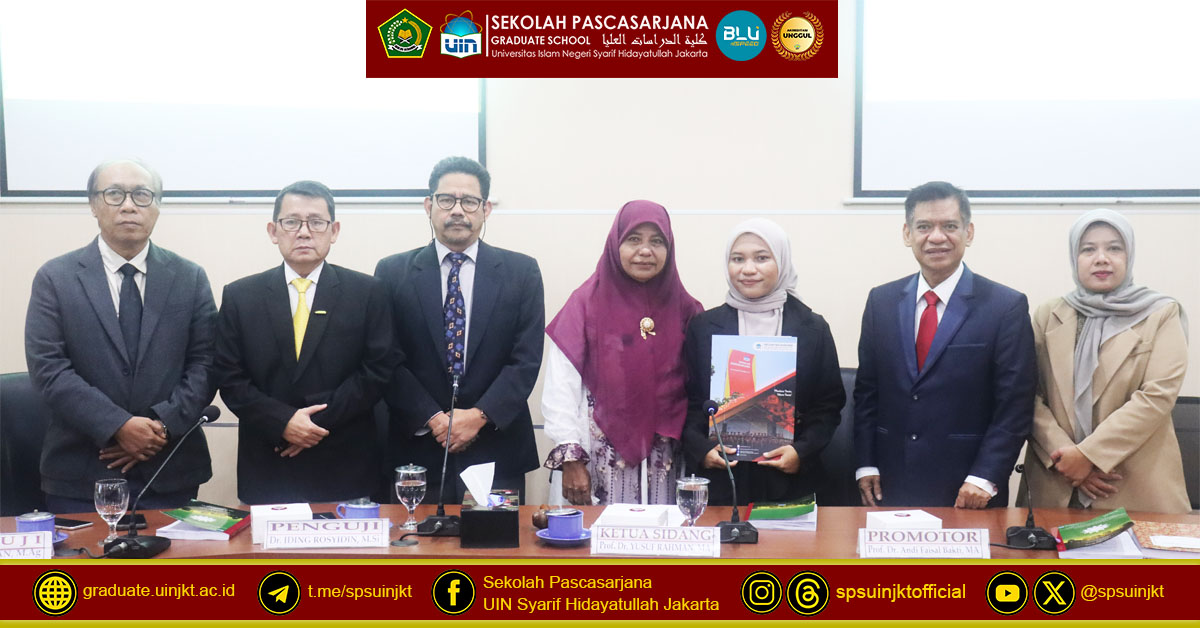
Mutia El Ilmi Putri Nasution Thesis Exam: Implementation of Religious Moderation through the Institutionalization of Teaching in Islamic Boarding Schools
SPs Theater Room UIN Jakarta, SPs NEWS - The Graduate School (SPs) of UIN Syarif Hidayatullah Jakarta held the 2803rd Thesis Exam at the SPs Theater Room of UIN Jakarta on Wednesday, February 18, 2026 with candidate Mutia El Ilmi Putri Nasution.
Mutia is a student of the Master of Islamic Studies program with a Concentration in Da'wah and Communication. His thesis was entitled "Implementation of Religious Moderation through the Institutionalization of Teaching at the Muhammadiyah Boarding School (MBS) Ki Bagus Hadikusumo Bogor Islamic Boarding School".
This research was born out of academic anxiety about the contemporary da'wah landscape that is increasingly open but fragmented, which if not managed properly, can become a gap for radicalism.
In front of the examiners, Mutia explained that the focus of his research targets two crucial dimensions. The first is the aspect of policy implementation in the formation of moderate dai cadres which includes communication, resources, disposition, and bureaucratic structure. The second is how the value of moderation is institutionally "rooted" through the regulative, normative, and cognitive framework of pesantren culture.
Interestingly, this thesis uses the lens of the Religious Moderation policy under the umbrella of the Ministry of Religion of the Republic of Indonesia in 2019. With qualitative methods and constructivist paradigms, Mutia conducts field investigations through in-depth interviews, observations, and documentation that integrates the discipline of da'wah with communication science.
In his argument, Mutia uses the analytical knife of George C. Edwards III's policy implementation theory and Richard W. Scott's institutional theory. He emphasized that Islamic educational institutions play a vital role in internalizing waṣaṭiyyah values through a da'wah curriculum based on the principles of tablīgh, taghyīr, takwīn al-ummah, and khayriyyah al-ummah.
The findings at MBS Ki Bagus Hadikusumo Bogor show that moderation has been institutionalized through three solid pillars. Regulatively, this can be seen in the rules and supervision mechanisms. Normatively, the value of responsibility and collective leadership is the breath of activity, while cognitive-culturally, the teacher's example is the key to student habituation.
The dynamics of communication within the pesantren are also uniquely captured. Mutia found that there is a fluid dialogical pattern between educators and students, even though at the leadership level it is still dominated by instructional patterns. This shows that there is a clear bureaucratic structure in maintaining the stability of the values taught.
Regarding resources, this research reveals that although the available human resources are adequate, the distribution is not completely even. Policy implementers in the field show a positive disposition or attitude towards the value of moderation, but Mutia gave a critical note that systemic evaluation in these institutions still needs to be optimized.
One of the most interesting points of this exam is Mutia's courage to make an "academic provocation" by rejecting the thesis of several previous researchers. He emphatically denied the statements of Feri Samandes (2021) and Dedi Sahputra Napitupulu and Hefni (2020) who stated that religious moderation in pesantren has been absolutely effective.
For Mutia, these claims of effectiveness need to be reviewed because the process of institutionalization is a continuous journey, not an instant result. However, he still stands in the same line as his predecessors in viewing pesantren as the main defense fortress to sow the value of tolerance through the path of da'wah regeneration.
Mutia's success in defending this thesis is expected not only to be a theoretical contribution to da'wah and communication science, but also to be a practical guide for Islamic boarding schools in Indonesia in producing moderate, tolerant, and progressive dadi.
Mutia successfully defended his thesis under the guidance of Prof. Dr. Andi Faisal Bakti, MA, and was tested in front of a board of examiners consisting of Prof. Dr. Yusuf Rahman, MA, Prof. Dr. Andi Faisal Bakti, MA, Dr. Arief Subhan, M.Ag, Dr. Iding Rosyidin, M.Si.
After paying attention to the thesis writing, the comments of the examiner team and the candidate's answers, the examiner team determined that Mutia graduated with the title of Very Satisfactory. Mutia El Ilmi Putri Nasution is the 2803rd Master in the field of Islamic Studies, in the Master's program of the Graduate School of UIN Syarif Hidayatullah Jakarta. (YES)