
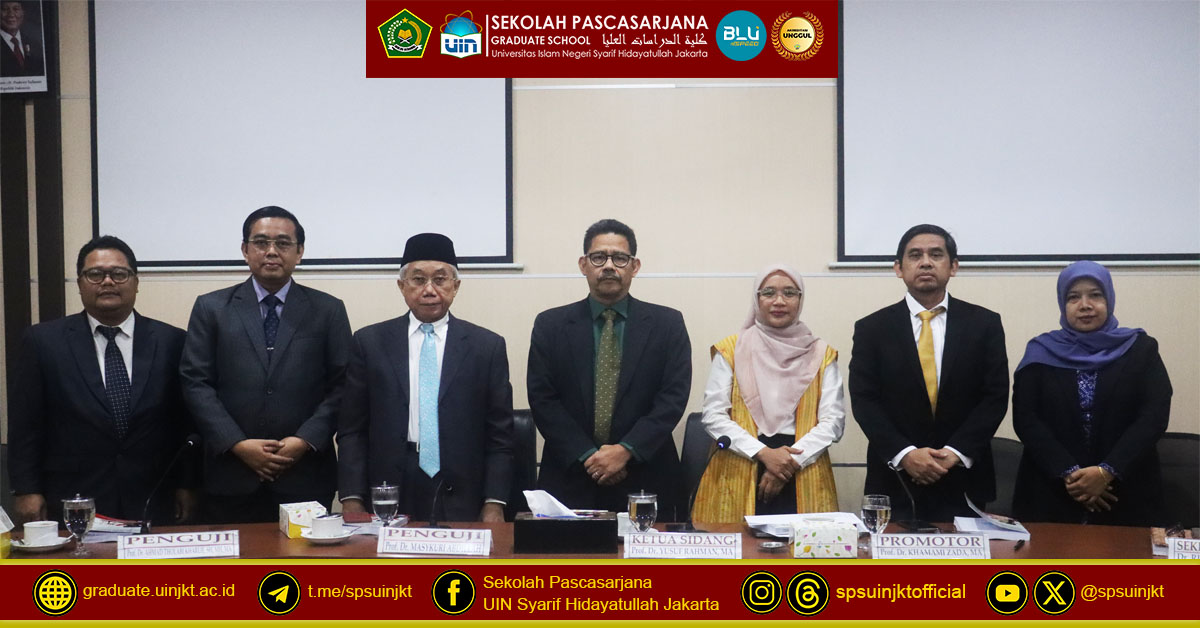
Nunuk Hidayati Doctoral Promotion Exam, State, Islam, and Minority Groups: The Dynamics of Legal Recognition and Protection of Believers in Indonesia
Auditorium of Prof. Dr. Suwito, MA SPs UIN Jakarta, SPs NEWS – The Graduate School (SPs) of UIN Syarif Hidayatullah Jakarta held the 1712th Doctoral Promotion Exam in the Theater Room of the Graduate School on Thursday, July 30, 2026 with promovendus Nunuk Hidayati.
Nunuk is a student of the Doctoral program in Islamic Studies with a concentration in the History of Islamic Civilization. His dissertation is entitled "State, Islam, and Minority Groups: The Dynamics of Legal Recognition and Protection of Believers in Indonesia". This research raises crucial issues regarding the relationship between state power, the existence of minority groups, and the fulfillment of citizens' constitutional rights.
Specifically, this study captures and sharply analyzes how the portrait of the dynamics of recognition and legal protection provided by the state to the community of believers in the country. This issue is an important concern considering the long struggle of believers in obtaining equality in the eyes of the law.
Nunuk's research sets three main focuses. First, it examines the persistent struggle of believers in demanding their basic rights. Second, understand the direction of government policies in responding to their existence. Third, evaluate the extent of the real implications of these public policies on the fulfillment of the basic rights of this minority group.
In order to obtain comprehensive data, Nunuk applied qualitative methods based on field research and document analysis. Primary data collection was carried out through in-depth interviews with key resource persons from five well-known faith communities in Indonesia, namely Sapta Darma, Sumarah, Sunda Wiwitan, Viaje, and Parmalim.
Meanwhile, the analysis of supporting documents was carried out carefully by examining various legal instruments and historical data. This research enriches the basis of his argument through the Constitutional Court Decision, official data of the Central Statistics Agency (BPS) of the Republic of Indonesia, laws and regulations, historical archives, and internal documents of activist organizations.
The findings of the study revealed that the struggle of the community of believers did not run linear, but was pursued through a combination of various strategies. The believers actively approach cultural, social, political, and legal channels in order to obtain formal recognition.
Nunuk noted that there has been a dynamic shift in government policy, which is slowly moving from a negative and discriminatory paradigm towards acceptance of the existence and equality of rights. One of the most important milestones is the issuance of the Constitutional Court Decision Number 97/PUU-XIV/2016 which has had a real positive impact on the pattern of social acceptance in society.
However, the massive positive impact has not completely solved the basic problem. The study found that the state still shows doubts and ambiguities in positioning believers firmly—whether they are categorized as independent religions or outside the religious corridors in the national religious governance system.
Theoretically, this research reinforces the view of international legal expert Francesco Capotorti on the definition of a minority that is often identified with weak political positions and a strong drive to be recognized. However, Nunuk's findings refute Capotorti and Jamal al-Din's premise that they identify minorities solely with small quantities; Field facts show that the number of Confucianists is much less than the total number of believers.
In closing, this research emphasizes the importance of sustainable inclusive dialogue, comprehensive public policy formulation, and certainty of legal positions for believers. The implications of this doctoral research are expected to make a real contribution to public policy structuring, strengthening tolerance practices, and developing the study of religious and state relations in Indonesia.
Nunuk successfully defended his dissertation under the guidance of Prof. Dr. Rumadi, M.Ag and Prof. Dr. Khamami, MA, and was tested in front of a board of examiners consisting of Prof. Dr. Yusuf Rahman, MA Prof. Dr. Khamami, MA, Prof. Dr. Masykuri Abdillah, Prof. Dr. Ahmad Tholabi Kharlie, S.Ag, SH, MH, MA and Prof. Dr. Media Zainul Bahri, MA.
After paying attention to the writing of the dissertation, the comments of the examiner team and the answers of the promovendus, the examiner team determined that Nunuk Hidayati graduated with the predicate of Cum Laude. Nunuk Hidayati is the 1712th Doctor in the field of Islamic Studies, doctoral program of the Graduate School of UIN Syarif Hidayatullah Jakarta. (Jay A)