
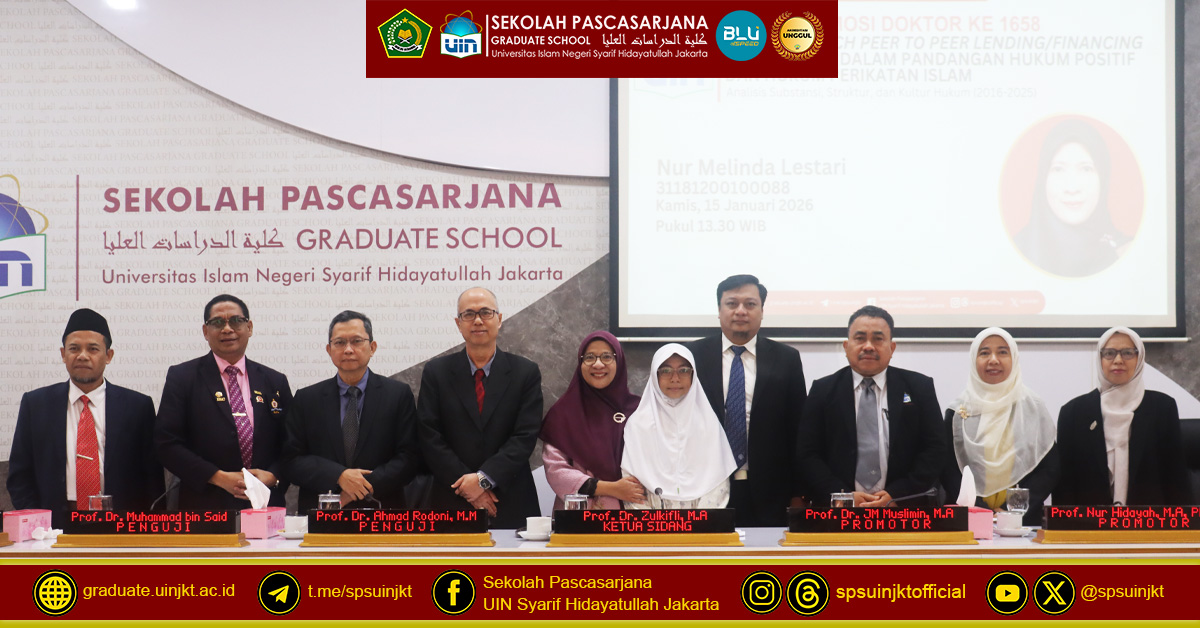
Nur Melinda Lestari Doctoral Promotion Exam: Fintech Peer to Peer Lending/Financing System in Indonesia in the Perspective of Positive Law and Islamic Alliance Law
Auditorium of Prof. Dr. Suwito, MA SPs UIN Jakarta, SPs NEWS - The Graduate School (SPs) of UIN Syarif Hidayatullah Jakarta held the 1658th Doctoral Promotion Exam in the Auditorium Room of Prof. Dr. Suwito, MA on Thursday, January 15, 2026 with promovenda Nur Melinda Lestari.
Melinda is a student of the Doctoral program in Islamic Studies with a concentration in Sharia Economic Law. His dissertation is entitled "Fintech Peer to Peer Lending/Financing System in Indonesia in the Perspective of Positive Law and Islamic Perikatan Law: An Analysis of Legal Substance, Structure, and Culture (2016-2025)".
This dissertation dissects the complexities of digital finance from three main perspectives: substance, structure, and legal culture. In front of the examiners, Nur Melinda emphasized the importance of reviewing the position of consumers who are often in a weak bargaining position amid the rapid flow of financial digitalization.
Through a qualitative approach and empirical case studies, this study reveals the fact that the current regulations, ranging from the ITE Law to the latest POJK No. 40/2024, have not been fully able to fortify society. Especially for victims of illegal fintech, the available legal protection is still considered very minimal and does not provide solid legal certainty like protection in conventional banking.
One of the crucial findings in the aspect of legal substance is the existence of a "Vage Norm" or vague norm in the applicable rules. Nur Melinda highlighted the violation of the principle of pacta sunt servanda (promises must be kept) and weaknesses in digital contracts. Furthermore, from the perspective of sharia, it is found that there is an element of gharar or ambiguity that has the potential to harm one party and is contrary to the rules of the Islamic Alliance Law.
Structurally, this study criticizes the role of institutions such as OJK, BI, DSN-MUI, and AFPI. Despite having authority, these institutions are considered to be still administrative and have not been equipped with a strong enough law enforcement mechanism to take aggressive action against violations. This creates a loophole where the rules become mere procedures without real fangs of execution.
This condition is exacerbated by the legal culture of Indonesian society which is still trapped in pragmatism. Nur Melinda noted that the weak due diligence of consumers before transacting, coupled with patrimonial culture, makes the position of the community even more vulnerable. Low understanding of preventive law is the main entrance to the rampant cases of default and billing terror that have gone viral in recent years.
Interestingly, this study expressly rejects the market efficiency theory put forward by Philippon and Vives. Nur Melinda argues that market efficiency will never be achieved if there is legal uncertainty and extreme information imbalance between fintech operators and consumers. He prefers to rely on Hans Kelsen's theory of legal certainty and Lawrence M. Friedman's legal system as the foundation of his analysis.
The novelty offered in this study is a model of legal reconstruction of agreements based on legal pluralism. This model is an innovation that combines the principles of the Civil Code with the principles of Islamic Alliance Law in harmony. The goal is clear: to create a fintech ecosystem that is not only technologically sophisticated, but also morally and legally just.
This research is not only a pile of papers in the library, but also an "alarm" for regulators to immediately improve fintech regulations to be clearer, healthier, and in favor of consumer protection in order to maintain national economic stability. Melinda is expected to continue to oversee the issue of sharia and digital economic law in Indonesia in order to realize justice for all levels of society.
Nur Melinda Lestari successfully defended her dissertation under the guidance of Prof. Dr. JM Muslimin, MA and Prof. Nur Hidayah, S.Ag, SE, MA, MA, Ph.D, and was tested in front of a board of examiners consisting of Prof. Dr. Zulkifli, MA, Prof. Dr. JM Muslimin, MA, Prof. Nur Hidayah, S.Ag, SE, MA, MA, Ph.D, Prof. Dr. Ahmad Rodoni, MM, Prof. Dr. Muhammad Bin Said and Dr. H.M. Nurul Irfan, M.Ag.
After paying attention to the dissertation writing, the comments of the examiner team and the promovenda's answers, the examiner team determined that Nur Melinda Lestari graduated with the title of Very Satisfactory. Nur Melinda Lestari is the 1658th Doctor in the field of Islamic Studies, in the doctoral program of the Graduate School of UIN Syarif Hidayatullah Jakarta. (JA)