
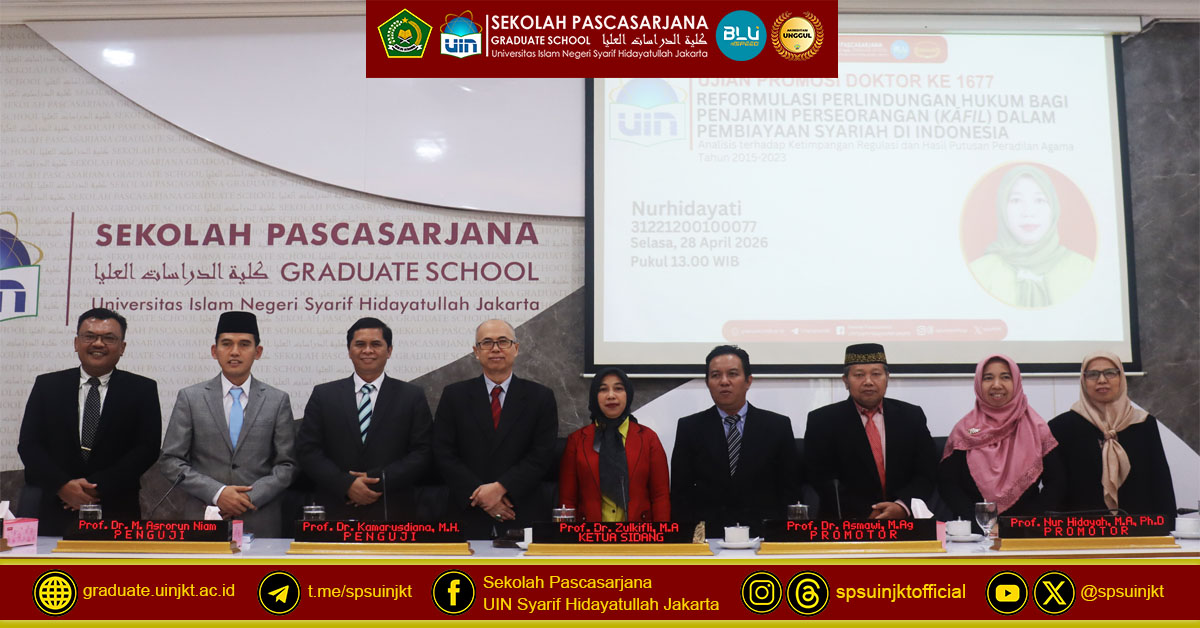
Nurhidayati Doctoral Promotion Exam, Reformulation of Legal Protection for Individual Guarantors (Kāfil) in Sharia Financing in Indonesia
Auditorium of Prof. Dr. Suwito, MA SPs UIN Jakarta, SPs NEWS – The Graduate School (SPs) of UIN Syarif Hidayatullah Jakarta held the 1677th Doctoral Promotion Exam in the Auditorium Room of Prof. Dr. Suwito, MA on Tuesday, April 28, 2026 with Nurhidayati's promovenda.
Nurhidayati is a student of the Doctoral program in Islamic Studies with a Concentration in Religion and Health. His dissertation is entitled "Reformulation of Legal Protection for Individual Guarantors (Kāfil) in Sharia Financing in Indonesia: An Analysis of Regulatory Inequities and the Results of Religious Court Decisions in 2015-2023". This research dissects the bitter reality behind the grandeur of the national Islamic banking industry.
This research departs from the author's deep concern about the weak legal position of individual guarantors or kāfil. Normatively in Islamic law, kafālah is a contract of tabarru' or help-helping oriented towards justice, but in practice, this noble value is often overlooked by the harshness of the banking system.
Nurhidayati highlighted the real inequality of regulations and the results of religious court decisions that tend to be impartial to the guarantor. He found that there was a gap between the idealism of Islamic law and the reality of the policies applied, so he felt the need to formulate corrective norms for the creation of more just policies.
One of the sharp points highlighted is the incompatibility between the concept of kafālah which is tabarruʿiyyah and positive legal practice. In the field, theguarantor or guarantor is often treated like a second debtor through a joint liability scheme, a practice that is considered far from the original sharia dignity.
Based on an in-depth analysis of 43 court decisions that have permanent legal force, Nurhidayati found surprising facts. Judges in religious courts apparently still refer to Articles 1820-1850 of the Civil Code in deciding cases, as if to override the existing sharia legal framework.
In fact, Indonesia already has sharia legal tools such as the Compilation of Sharia Economic Law (KHES), Compilation of Islamic Law (KHI), DSN-MUI Fatwa, to Law No. 21/2008 concerning Sharia Banking. However, these devices are often just administrative complements without strong binding power in the courtroom.
Nurhidayati explained that previous studies have not touched on the root of the problem regarding normative conflicts and inequality in power relations between banks, debtors, and guarantors. Through a normative-empirical approach, he uses Maqāṣid al-Syarīʿahand Critical Legal Theory to expose the existence of systemic structural injustices.
This research is even more weighty because it uses comprehensive primary data, ranging from regulatory studies, classical fiqh, to direct interviews with key actors. Nurhidayati explores the perspectives of judges, banks, notaries, legal practitioners, and guarantors who are victims of contract injustice.
It was found that in the transactions of muḍārabah, murābaḥah, and musyārakah mutanāqiṣah, the position of kāfil was very fragile. This is exacerbated by the dominance of banks as the owners of funds who have full power in determining the content of the contract, while the guarantor is in a position of "receive it" without adequate protection.
As a solution to this problem, Nurhidayati developed a scientific breakthrough that she called the "Substantive Protection Theory of Kāfil". This theory is designed as a corrective framework to compensate for the contractual dominance of banks and restore responsibility to a proportionate portion according to Islamic principles.
Not only that, he also offers the "Five-Step Maqāṣid Test" that can be used by judges as a guideline for judicial evaluation. This protection model includes three main pillars: normative reformulation through strengthening lex specialis regulations, transparent contract reform, and judicial reformulation that prioritizes substantive justice.
This dissertation is expected to be a strong academic text for Islamic regulators and banks in Indonesia. With the contribution of this fresh theory of sharia economic law, it is hoped that the guarantor protection system in the future will no longer be uneven, but in line with the true principles of sharia justice.
Nurhidayati successfully defended her dissertation under the guidance of Prof. Dr. Asmawi, M.Ag and Prof. Nur Hidayah, S.Ag, SE, MA, MA, Ph.D, and was tested in front of a board of examiners consisting of Prof. Dr. Zulkifli, MA, Prof. Dr. Asmawi, M.Ag, Prof. Nur Hidayah, S.Ag, SE, MA, MA, Ph.D, Prof. Dr. Kamarusdiana, MH, Prof. Dr. Ade Sofyan Mulazid, S.Ag, MH, Prof. Dr. H.M. Asrorun Ni'am Sholeh, MA.
After paying attention to the writing of the dissertation, the comments of the examiner team and the answers of the promovendus, the examiner team determined that Nurhidayati graduated with the title of Very Satisfactory. Nurhidayati is the 1677th Doctor in the field of Islamic Studies, doctoral program of the Graduate School of UIN Syarif Hidayatullah Jakarta. (JA)