
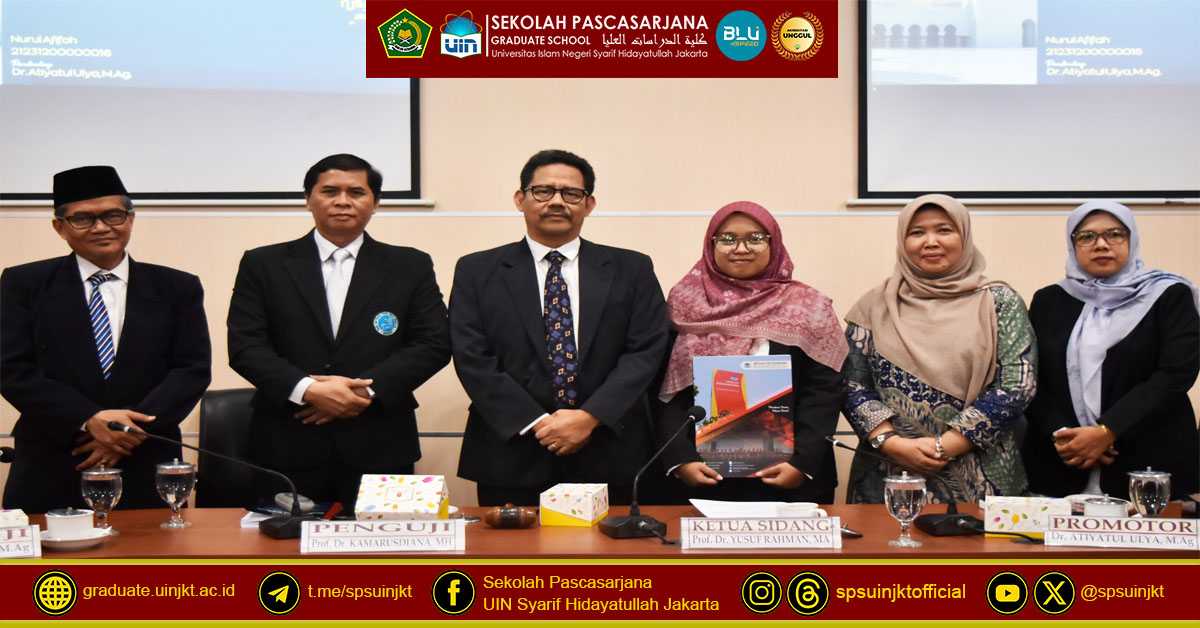
Nurul Afifah's Thesis Exam, Shifting Indonesian Muslim Scholars' Criticism of the 'Ā'ishah Marriage Hadith
SPs Theater Room UIN Jakarta, SPs NEWS - The Graduate School (SPs) of UIN Syarif Hidayatullah Jakarta held the 2816th Thesis Exam at the SPs Theater Room of UIN Jakarta on Monday, July 13, 2026 with candidate Nurul Afifah.
Nurul is a student of the Master of Islamic Studies program with a concentration in Hadith and Prophetic Tradition. His thesis is entitled "The Shift in Indonesian Muslim Scholars' Criticism of the Hadith of Marriage 'Ā'ishah r.a.: From Normative Textual to Progressive Contextual".
This research specifically highlights how religious texts are adopted, criticized, and contextualized by contemporary Islamic thinkers in Indonesia in response to the demands of the times.
Specifically, this study aims to analyze the category of criticism of four leading contemporary Muslim scholars in Indonesia on the hadith of the marriage of the Prophet Muhammad (PBUH) and 'Āisyah RA. Not only mapping criticism, Nurul also succeeded in uncovering the epistemological foundation (roots of knowledge) and the socio-political context that shaped the narrative of the criticism to become a living discourse.
The four central figures who are the object of study in this study are Husein Muhammad, Faqihuddin Abdul Kodir, Andi Rahman, and Muhammad Rofiq Muzakkir. To dissect the four thoughts, Nurul uses a qualitative method based on library research. He relied on primary data sources from the books and writings of the scholars, which were then reinforced through direct interviews.
In order to enrich perspectives and maintain academic validity, secondary data sources were also collected from various relevant studies and literature. Conceptually, this research relies on the framework of Critical Discourse Analysis (AWK) of the Norman Fairclough model as the main analytical knife, which is combined with the contemporary hadith criticism approach based on the theory of matan criticism (text content) of hadith from the legendary scholar Yūsuf al-Qaraḍāwī.
From the results of an in-depth analysis of the text, the study found that the four scholars built their critical arguments from different epistemological vantage points. Husein Muhammad and Faqihuddin Abdul Kodir moved from the framework of gender equality and maqāṣid al-sharīʻah (the universal goal of sharia). On the other hand, Andi Rahman relies on the integration of classical hadith methodology with a strict historical approach.
Meanwhile, Muhammad Rofiq Muzakkir operates a unique perspective on decolonization. This perspective is used to unravel the genealogy of Western discourse that tends to be biased and encompasses this issue of marriage. This difference in perspective shows that the narrative of criticism of Indonesian Muslim scholars is shaped by a very diverse epistemological paradigm, by placing the Qur'an and human welfare as its normative umbrella.
Interestingly, Nurul also proves that the criticism is not born in a vacuum, but is greatly influenced by social reality. The phenomenon of rampant child marriage in Indonesia, the discourse of colonialism, the discursive pressure of global Islamophobia, and the intensive dialogue with the discourse on human rights, child protection, and gender equality are the driving forces for the birth of this critical thinking. In fact, this dynamic of thinking has direct implications for the formulation of public policy in Indonesia.
Nurul Afifah's research has a unique position because it is different from the views of several world figures such as Amina Wadud (1999), Kecia Ali (2014), and Muzakkir (2023). If the previous figures emphasized the issue of this hadith on the perspective of gender hermeneutics, women's justice, and the historiography of the Prophet, Nurul actually took a route that went beyond all of that.
This thesis in-depth examines the mapping of criticism categories, epistemological foundations, and narrative constructions that are typically built by Indonesian Muslim scholars. Nurul argues that the diversity of critical narratives in Indonesia is the result of a very complex interaction between the progressive epistemological paradigm and the real pressures of the socio-religious context in the country.
In conclusion, the scholars' criticism represents a major leap: a shift in the interpretation of hadith from a normative textual to a contextual one oriented towards maqāṣid al-sharī'ah and gender justice. This dynamic shows that the understanding of hadith in Indonesia is now built through a variety of rich methodological approaches ranging from sanad criticism, matan, to hermeneutic analysis that strengthens Indonesia's position as the center of the development of contemporary hadith discourse in the world.
Nurul successfully defended her thesis under the guidance of Dr. Atiyatul Ulya, M.Ag, and was tested in front of a board of examiners consisting of Prof. Dr. Yusuf Rahman, MA, Dr. Atiyatul Ulya, M.Ag, Prof. Dr. Kamarusdiana, MH, Dr. Ahmad Fudhaili, M.Ag.
After paying attention to the thesis writing, the comments of the examiner team and the candidate's answers, the examiner team determined that Nurul Afifah graduated with the title of Very Satisfactory. Nurul Afifah is the 2816th Master in the field of Islamic Studies, in the Master's program of the Graduate School of UIN Syarif Hidayatullah Jakarta. (Jay A)