
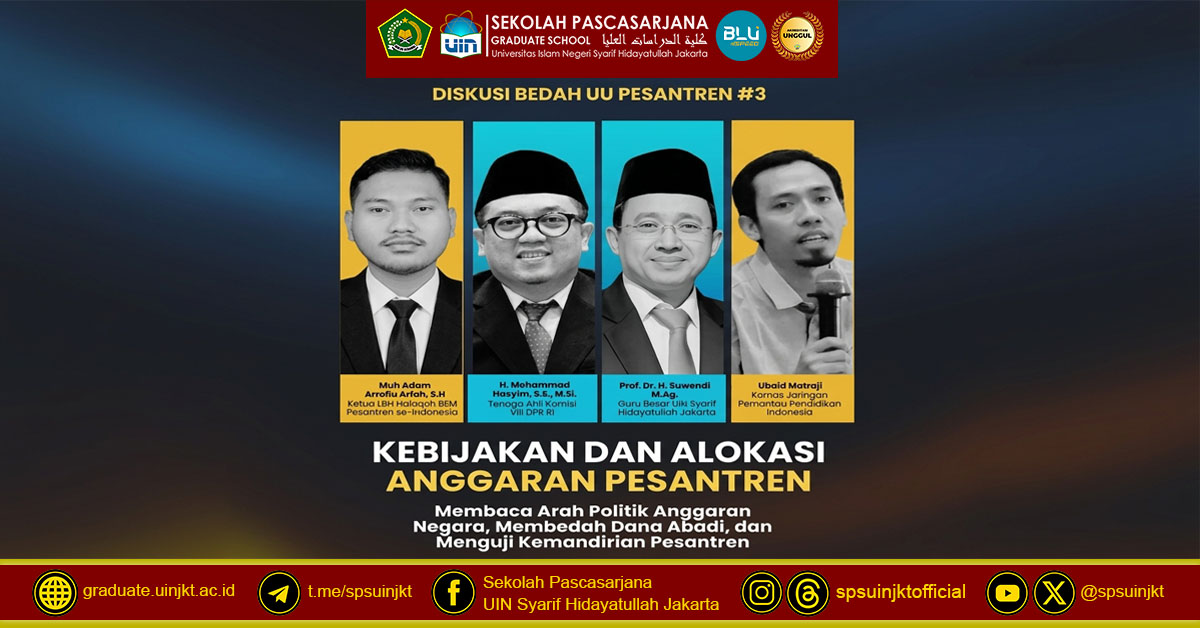
Professor of SPs UIN Jakarta: Recognition of Islamic Boarding Schools Needs to Be Followed by Budget Affirmation
Jakarta, SPs NEWS - Professor of UIN Syarif Hidayatullah Jakarta, Prof. Dr. H. Suwendi, M.Ag., said that state recognition of pesantren needs to be followed by policy and budget affirmations. According to him, recognition of pesantren does not stop at the regulatory aspect, but needs to be realized in support that allows pesantren to continue to improve the quality of education and strengthen their contribution to society.
This was conveyed by Suwendi in a public discussion themed "Pesantren Budget Policies and Allocations" organized by the Islamic Boarding School Community Network (JMP), Thursday (24/9/2026). The activity, which was held online, was attended by various groups, including officials, pesantren caregivers, lecturers, students, and observers of pesantren issues.
Present as resource persons were Muh Adam Arrofiu Arfah, S.H., Chairman of LBH Halaqoh BEM Islamic Boarding Schools throughout Indonesia; H. Mohammad Hasyim, S.S., M.Si., Expert of Commission VIII of the House of Representatives of the Republic of Indonesia; Suwendi; and Ubaid Matraji, National Coordinator of the Indonesian Education Monitoring Network (JPPI). The discussion was moderated by Kombang Tua Siregar, M.A., an alumnus of the Postgraduate School of UIN Jakarta.
Suwendi said that Law Number 18 of 2019 concerning Islamic Boarding Schools brought important changes in the relationship between Islamic boarding schools and the state through three aspects, namely recognition, regulation, and affirmation.
"The Islamic Boarding School Law provides massive recognition or recognition of pesantren education, presents regulations that support Islamic boarding schools, as well as opens up space for affirmation through budgets and governance that accommodate the existence of Islamic boarding schools," said Suwendi.
According to him, the recognition of Islamic boarding schools does not stop at formal recognition through regulations. This recognition needs to be translated into policies that provide space for Islamic boarding schools to develop, improve the quality of education, and strengthen their contribution to society and the nation.
Suwendi related this to Axel Honneth's thinking about recognition. According to him, legal recognition needs to be followed by social solidarity so that recognition of a group does not stop at the formal aspect, but is present substantively in people's lives.
"Legal recognition alone, without accompaniment in the realm of social solidarity, has the potential to give birth to misrecognition, which is formal recognition but not yet substantively intact," he explained.
In the context of Islamic boarding schools, funding support is part of the state's affirmation. Presidential Regulation Number 82 of 2021 concerning Funding for the Implementation of Islamic Boarding Schools has opened sources of funding from the central government, local governments, Islamic boarding school endowment funds, the community, and other legal and non-binding sources.
However, Suwendi assessed that there are still challenges in its implementation, especially related to education funding regulations and the authority of local governments. Therefore, policy synchronization is needed so that the recognition of Islamic boarding schools can continue to become a more real affirmation, without losing the character and independence of Islamic boarding schools.
Meanwhile, Expert of Commission VIII of the House of Representatives of the Republic of Indonesia, H. Mohammad Hasyim, highlighted the distribution of the education budget, which according to him is not proportional between general education and Islamic education. According to him, in the 2019-2024 range, Islamic education received a relatively smaller allocation even though the education budget already has a mandate of 20 percent of the state budget.
"The revision of Law Number 20 of 2003 concerning the National Education System can be one of the entrances to strengthen Islamic education regulations. However, the process is inseparable from political and policy dynamics," he said.
From a legal perspective, Muh Adam Arrofiu Arfah assessed that the character of pesantren independence should not be used as an excuse to limit state support. According to him, the independence of pesantren is related to culture, spirituality, curriculum, and moral leadership, it does not mean that pesantren must be completely independent in financing education.
"The independence of pesantren is in the realm of culture, spirituality, curriculum, and moral leadership, not in the financial realm," he said.
Adam encourages the existence of objective, measurable, and predictable budget parameters so that state support can strengthen the independence of Islamic boarding schools. With the certainty of funding, Islamic boarding schools can focus more on curriculum development, quality improvement, and social contribution.
Meanwhile, JPPI National Coordinator Ubaid Matraji highlighted the problem of budget absorption in local governments. According to him, every year there is still a large amount of budget that is not absorbed.
"Every year there is a budget that is not absorbed and the amount is quite fantastic. Hundreds of trillions of budgets in local governments are not absorbed every year. This is very unfortunate," said Ubaid.
The JMP discussion emphasized that the discussion of the pesantren budget is not solely related to the amount of funds, but also concerns state recognition, regulations, and affirmations. Policy and budget support is expected to further strengthen pesantren as an integral part of the national education system, while maintaining its uniqueness and independence.
Thus, pesantren are not placed solely as recipients of assistance, but as strategic partners of the state in building education, shaping the character of the nation's generation, developing religious life, and making social contributions to society. (SWD/Jay A)