
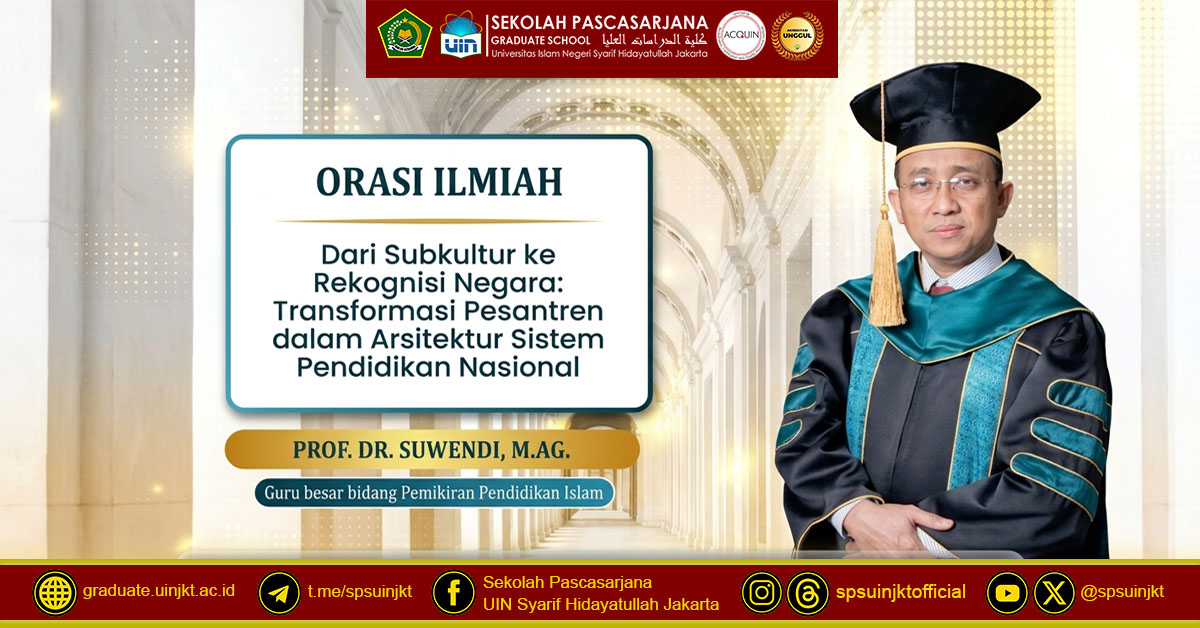
Professor of UIN Jakarta Suwendi: Islamic Boarding School Subculture Becomes an Identity in the National Education System
Jakarta, SPs NEWS - Professor of UIN Syarif Hidayatullah Jakarta, Prof. Dr. H. Suwendi, M.Ag., emphasized that the transformation of pesantren from subculture to state recognition does not mean eliminating its identity and distinctiveness. On the contrary, state recognition must be a way to place pesantren fairly as an integral part of the national education system.
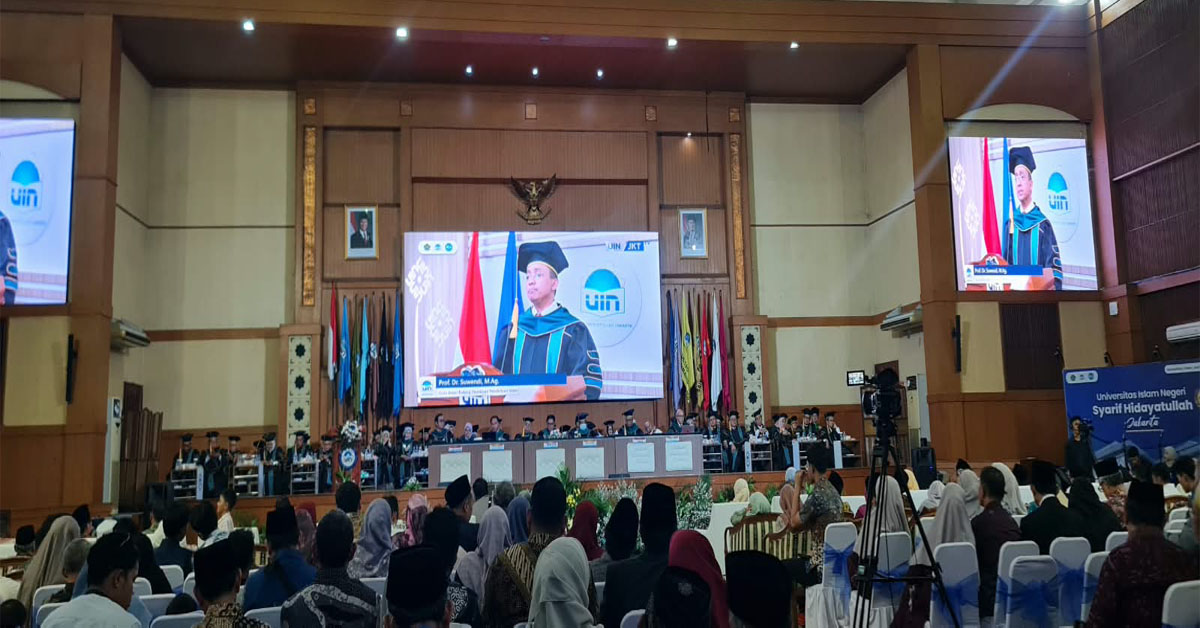
This was conveyed by Suwendi in his inauguration speech as a Professor of Islamic Education Thought at the Graduate School of UIN Syarif Hidayatullah Jakarta, Wednesday (30/9/2026). In a speech entitled "From Subculture to State Recognition: The Transformation of Islamic Boarding Schools in the Architecture of the National Education System", Suwendi outlined the long dynamics of the relationship between Islamic boarding schools and the state while offering a number of approaches to strengthen the position of Islamic boarding schools in the national education system.
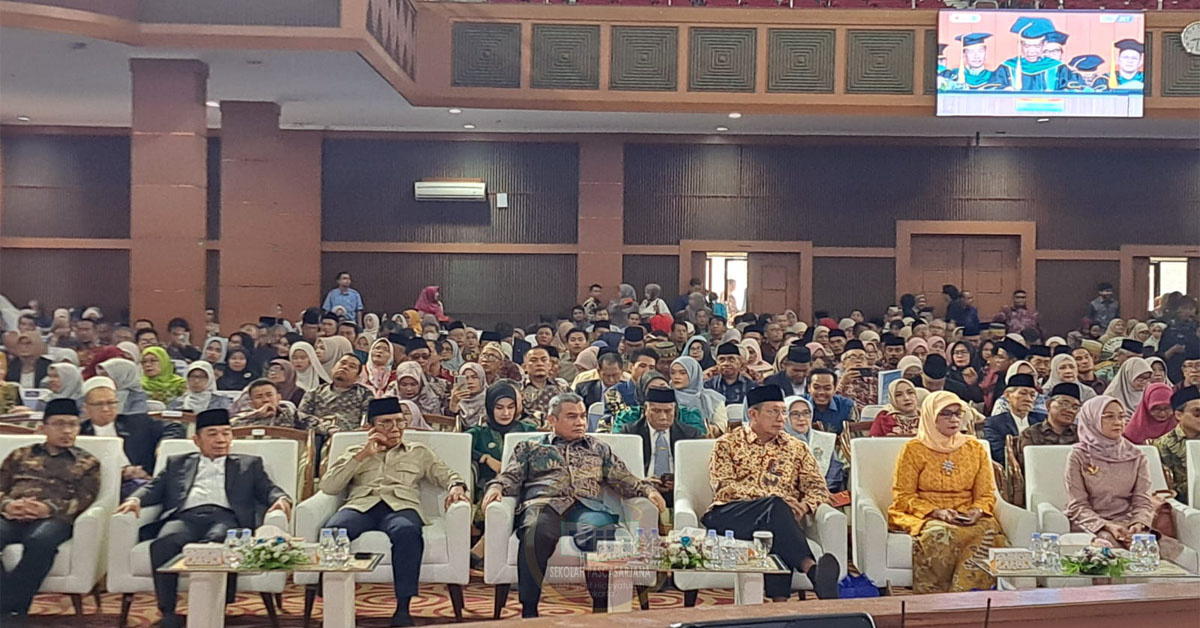
Suwendi was inaugurated along with 12 other professors in a procession attended by thousands of invitees. Present were the Minister of Religion of the Republic of Indonesia Prof. Dr. KH. Nasaruddin Umar, M.A., Minister of Elementary and Secondary Education of the Republic of Indonesia Prof. Dr. Abdul Mu'ti, M.Ed., Minister of Religion for the period 2014–2019 Lukman Hakim Saifuddin and Hj. Trisna Willy, Director General of Research and Development of the Ministry of Education and Science Fauzan Adziman, Chairman of the Indonesian Election Commission Afifuddin, Head of Education and Training of the National Police Komjen Pol. R. Z. Panca Putra S., Director of PKUMI Prof. Ahmad Thib Raya, as well as a number of ministries/institutions officials, university leaders, professors, lecturers, community leaders, and other invited guests.
According to Suwendi, the relationship between pesantren and the state has experienced its own dialectic. In the course of almost seven decades after independence, the relationship has tended to be diametrical or, in other words, "merged but not yet united." Pesantren has become an important part of nation-building, but at the same time it still experiences alienation from the mainstream of the national education system.
Important changes began to be seen when the state established Presidential Decree Number 22 of 2015 concerning Santri Day. This policy, according to Suwendi, became one of the momentum that encouraged a change in the state's perspective on Islamic boarding schools and then continued with the birth of Law Number 18 of 2019 concerning Islamic Boarding Schools.
"The birth of this law is the culmination of this fundamental change. Islamic boarding schools are no longer alienated as stand-alone educational institutions, but are integrated into a single national education system, while still guaranteeing their distinctiveness and characteristics," said Suwendi.
He explained that the length of the negotiation process between pesantren and the state is partly due to the lack of strong attention and understanding of the character of pesantren as a subculture of Indonesian society. In Gus Dur's perspective, said Suwendi, pesantren have a distinctive value system, leadership pattern, scientific reference, and social structure. However, subculture does not mean a weak or inferior fringe group. The structural and cultural autonomy of pesantren is actually part of the social wealth of the Indonesian nation.
"State recognition should not be interpreted as uniformity or loss of Islamic boarding school subculture. On the contrary, the law actually accommodates the peculiarities of Islamic boarding schools, not imposing them uniformly with other educational patterns," he explained.
In reading these changes, Suwendi uses the perspective of the recognition theory of Axel Honneth, a German philosopher and sociologist who is known as one of the main figures of the third generation of the Frankfurt School. Within Honneth's framework, recognition takes place in the realm of affective, legal, and social solidarity.
Therefore, continued Suwendi, legal recognition of Islamic boarding schools needs to be followed by social and institutional support. Recognition that stops at the regulatory aspect without equal support has the potential to give birth to misrecognition, namely recognition that has been formally given but has not been fully present substantively.
To ensure that the recognition runs in a complete and sustainable manner, Suwendi offers three approaches. First, the principle of "one house has many rooms". According to him, the national education system is one house in which there are various types and paths of education. Each has characteristics and peculiarities that need to be respected.
"There is no room that is more legitimate than any other room, just as there is no type of education that is more valid than any other type of education," he said.
Therefore, pesantren education should not be forced to follow the patterns, standards, or curriculum of other types of education. At the same time, other types of education also do not have to conform to the pattern of pesantren education.
Second, the Gross Participation Rate (APK) approach. Suwendi assessed, if the education APK is used as one of the indicators of national education participation, then the existence of formal Islamic boarding school education units needs to be placed proportionally in the system.
Formal Diniyah Education, Mu'adalah, and Ma'had Aly are part of the formal Islamic boarding school education unit. Therefore, according to Suwendi, all three have the right as well as part of the state's obligation to obtain facility support and financing like other formal education units.
"If BOS, BOPTN, educator certification, and other financing affirmations flow to schools, madrasas, and universities, then Formal Early Childhood Education, Mu'adalah, and Ma'had Aly are also entitled to obtain it," he said.
Third, the multi-entry multi-exit approach. This approach allows students to enter a certain level of education through various paths and types of education and continue their education to the next level without being hampered by the barriers of the type of education.
With this approach, graduates of formal Islamic boarding school education units, according to Suwendi, need to get an equal opportunity to continue their education at the next level in various types of education. The diplomas obtained must also have a civil effect equivalent to diplomas from other formal education units.
Suwendi emphasized that the transformation of pesantren from subculture to state recognition is ultimately not a process to merge the identity of pesantren identity. This transformation actually emphasizes the state's obligation to recognize, protect, and treat pesantren fairly in the architecture of the national education system.
"Pesantren are not alienated, but are fully integrated into a single national education system, without losing their characteristics as a subculture," he concluded.(SWD/JA)