
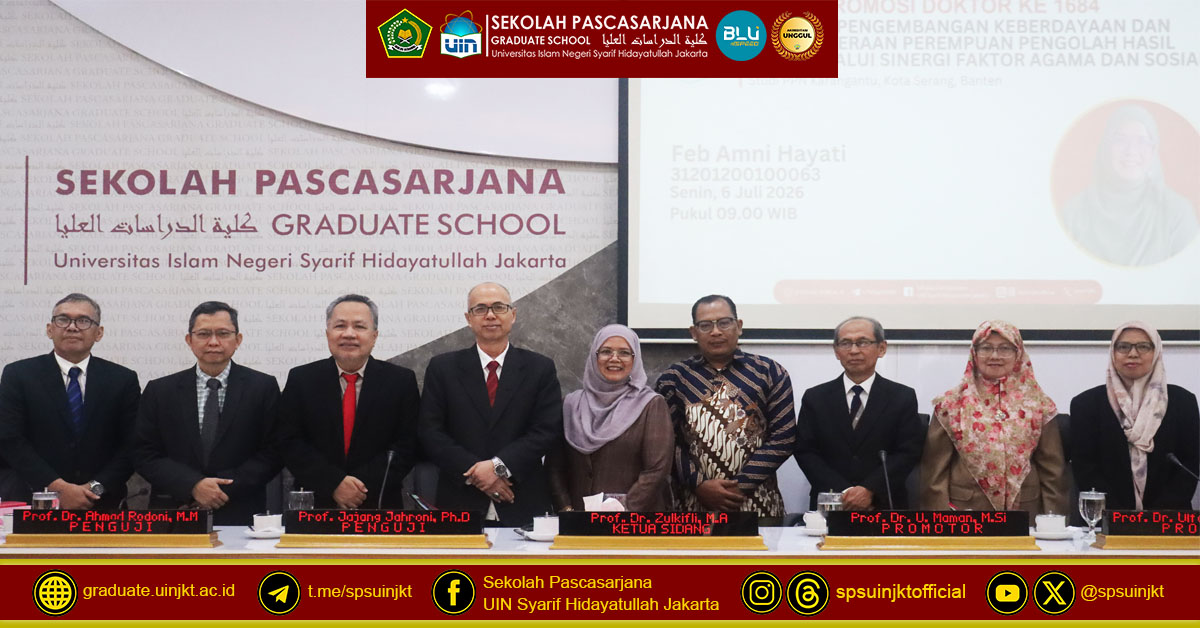
Promotion Exam of Dokto Feb Amni Hayati, Strategy for the Development of Empowerment and Welfare of Women Marine Product Processors through the Synergy of Religious and Social Factors
Auditorium of Prof. Dr. Suwito, MA SPs UIN Jakarta, SPs NEWS – The Graduate School (SPs) of UIN Syarif Hidayatullah Jakarta held the 1684th Doctoral Promotion Exam in the Auditorium Room of Prof. Dr. Suwito, MA on Monday, July 6, 2026 with promovenda Feb Amni Nurhayati.
Feb is a student of the Doctoral program in Islamic Studies with a concentration in Islamic Economics. Her dissertation is entitled "Strategy for the Development of Empowerment and Welfare of Women Marine Product Processors Through the Synergy of Religious and Social Factors (Karangantu PPN Study, Serang City, Banten)". This study captures the reality of the lives of women who process marine products which have a dual and very strategic role in supporting the family economy.
Despite being the backbone of the household economy and fishing communities, these women are apparently still shackled by structural inequality. This condition has a direct impact on their low level of empowerment and welfare. This real phenomenon is commonly found at the Nusantara Fisheries Port (PPN) Karangantu, Kasemen District, Serang City.
Through his presentation, Feb explained that the tangled threads of problems in the Karangantu VAT are very complex. Starting from unstable income, double burden as a housewife as well as a breadwinner, to limited capital and technology. In addition, their lack of involvement in decision-making and the lack of optimal integration of religious values in economic strengthening exacerbate the situation.
Departing from this problem, this research aims to explore three main things. First, analyzing the real conditions of welfare and the level of empowerment of local women. Second, testing the influence of religious and social factors on their empowerment. Third, formulate the best strategy model based on spiritual and social values to boost the living standards of coastal women.
To dissect this problem, Dr. Feb Amni Hayati uses a mixed methods approach. Quantitative analysis was carried out using Structural Equation Modeling-Partial Least Squares (SEM-PLS) to test the relationship between variables. Meanwhile, its qualitative approach is strengthened with SWOT analysis to produce grounded and applicable strategy recommendations.
The results of field research show a rather worrying portrait, where the economic welfare of women seafood processors in Karangantu is still relatively low. This is triggered by their erratic daily income and their high dependence on middlemen. This middleman chain is the one that often locks their bargaining positions in the trade sector.
From the perspective of empowerment, women are actually independent in managing domestic or household finances. Unfortunately, they are still very limited in determining the selling price of processed products, getting access to formal training, and utilizing more modern fish processing technology.
Interestingly, the results of the SEM-PLS analysis prove that religious and social factors play a very positive and significant role. The synergy between spiritual values and social ties has been proven to be effective in strengthening decision-making capacity, building psychological resilience when facing famine, and improving the quality of well-being they feel psychologically and physically.
Based on the SWOT analysis, the position of women seafood processors in the Karangantu VAT is in Quadrant II. This position recommends an ST (Strength-Threat) strategy as a priority. This means that coastal women must maximize their internal strength and social capital to fortify themselves and mitigate various external threats, including market price games.
In closing, the novelty of this study succeeded in giving birth to an integrative strategy model that places religion and society as the twin pillars of sustainable development for coastal women. These findings complement previous research by Jorge Torre et al. (2019) regarding local potential, but give a new color to Stacey's (2021) study which has only focused on physical infrastructure and market access.
Feb successfully defended his dissertation under the guidance of Prof. Dr. Ulfah Fajarini, M.Si and Prof. Dr. U. Maman, M.Si, and was tested in front of a board of examiners consisting of Prof. Dr. Zulkifli, MA, Prof. Dr. Ulfah Fajarini, M.Si, Prof. Dr. U. Maman, M.Si, Prof. Dr. Ahmad Rodoni, MM, Prof. Jajang Jahroni, MA, Ph.D, Dr. Indo Yama, SE, MAB.
After paying attention to the writing of the dissertation, the comments of the examiner team and the answers of the promovendus, the examiner team determined that Feb Amni Hayati graduated with the title of Very Satisfactory. Feb Amni Hayati is the 1684th Doctor in the field of Islamic Studies, a doctoral program at the Graduate School of UIN Syarif Hidayatullah Jakarta. (JA)