
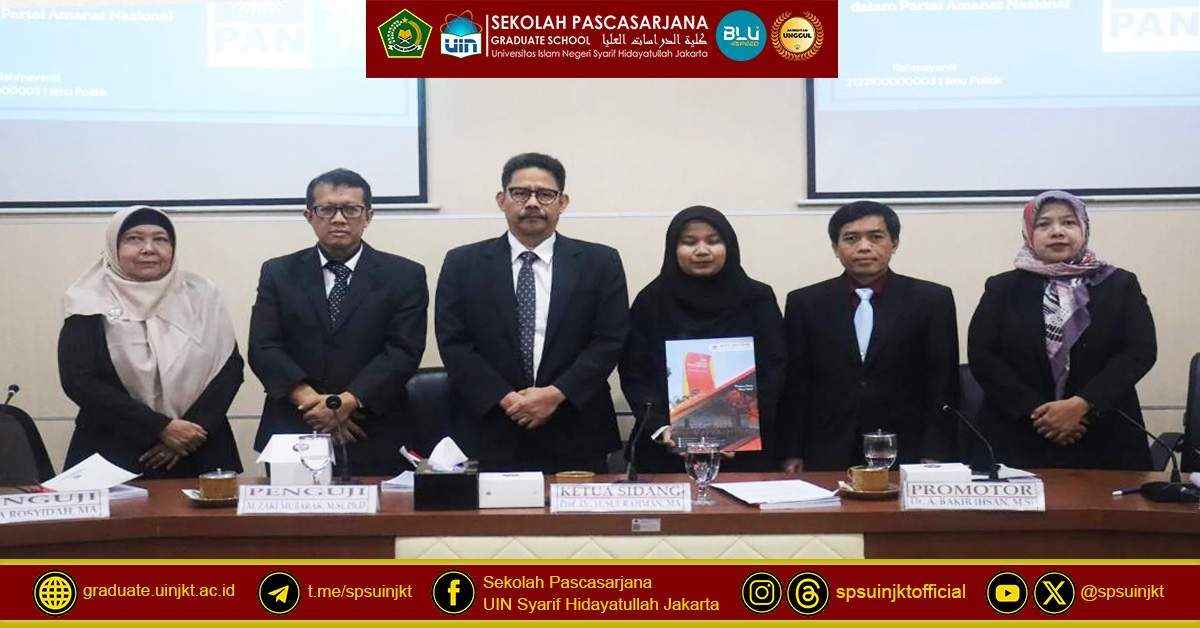
Rahmayanti Thesis Exam: Muhammadiyah Political Movement in the National Mandate Party
SPs Theater Room UIN Jakarta, SPs NEWS: The Graduate School of Syarif Hidayatullah State Islamic University Jakarta held the 2789th Thesis Exam in the SPs Theater Room of UIN Jakarta, on Friday, December 12, 2025 with candidate Rahmayanti.
Rahmayanti is a student of the Master of Islamic Studies study program with a concentration in Political Science. Rahmayanti wrote a thesis entitled "Muhammadiyah Political Movement in the National Mandate Party".
The dynamics of relations between religious civil society organizations and political parties in Indonesia are often in the spotlight, raising questions about the limits of engagement and its impact on democracy.
Rahmayanti's research specifically aims to analyze the complexity of interactions between religious organizations (Muhammadiyah) and political parties (PAN) in the Indonesian democratic landscape. This thesis expressly rejects the conventional view that tends to judge that the involvement of religious organizations in politics is a threat that can erode the moral independence, purity of da'wah, and the institutional autonomy of the organization.
Rahmayanti argues the opposite: the political participation of religious organizations, if properly institutionalized, can actually function as a democracy booster. According to him, this role is realized through the institutionalization of public ethical values and the implementation of the function of moral control which is urgently needed against rationality and potential deviations of power.
This thesis provides an important emphasis that the involvement of religious civil society organizations is not always synonymous with the politicization of religion. Rather, it can be interpreted as an "ethical process" that aims to affirm and instill the moral role of civil society in the arena of political life that is often considered to be fraught with pragmatic interests.
The historical and ideological relationship between Muhammadiyah and the National Mandate Party (PAN) was chosen as a representative case study. The relationship between the two, since the birth of PAN after the 1998 Tanwir Muhammadiyah Decision, is considered an ideal laboratory to understand the negotiations that occur between the morality of da'wah held by Muhammadiyah and the political rationality that often has to be carried out by PAN cadres in parliament and government.
Rahmayanti uses a descriptive qualitative approach through case studies, supported by in-depth interviews, observations, and document analysis that focuses on the management period of PP Muhammadiyah (2020–2027) and DPP PAN (2020–2025). His analysis is strengthened by a solid theoretical framework, namely Sutoro Eko's Theory of Political Relations which examines the interaction of the state, parties, and civil society, and the A. Bakir Ihsan Civil Society Theory which places religious organizations as vital moral forces in the political space.
The results of the study show that there are four phases of dynamic relationship between Muhammadiyah and PAN. These phases are hegemonic, collaborative, fragmentative, and autonomous. These four phases clearly illustrate the dialectic and tug-of-war that occurs between the idealism of da'wah values carried out by Muhammadiyah and the practical political interests and demands faced by PAN.
In addition to these four relationship phases, the research also succeeded in identifying three common forms of relationships, namely participatory, programmatic, and personal relationships. Most interestingly, however, this thesis managed to find a new form, namely the relationship of moral opposition. This form of moral opposition arises when Muhammadiyah institutionally distances itself and provides ethical criticism of PAN's policies or actions that are considered deviant from the values of the ummah and nationality.
Rahmayanti concluded that the Muhammadiyah Political Movement in PAN, instead of being a threat, is an important mechanism for the institutionalization of public ethics. This involvement, according to his thesis, contributes significantly to encouraging the creation of substantive democracy in Indonesia, where politics not only runs on the basis of power and interests, but is also controlled by morality and the noble values of civil society.
Rahmayanti's thesis makes a valuable scientific contribution, emphasizing that the moral strength of civil society is an asset, not a burden, in advancing the quality of Indonesian democracy towards more ethical and responsible state governance.
Rahmayanti successfully defended her thesis under the guidance of Dr. A. Bakir Ihsan, M.Si, and was tested in front of a board of examiners consisting of Prof. Dr. Yusuf Rahman, MA, Dr. A. Bakir Ihsan, M.Si, Dr. Ida Rosyidah, MA and M. Zaki Mubarak, M.Si, Ph.D.
After paying attention to the thesis writing, the comments of the examiner team and the candidate's answers, the examiner team determined that Rahmayanti graduated with the title of Very Satisfactory. Rahmayanti is the 2789th master in the field of Islamic Studies, in the master's program of the Graduate School of UIN Syarif Hidayatullah Jakarta. (JA)