
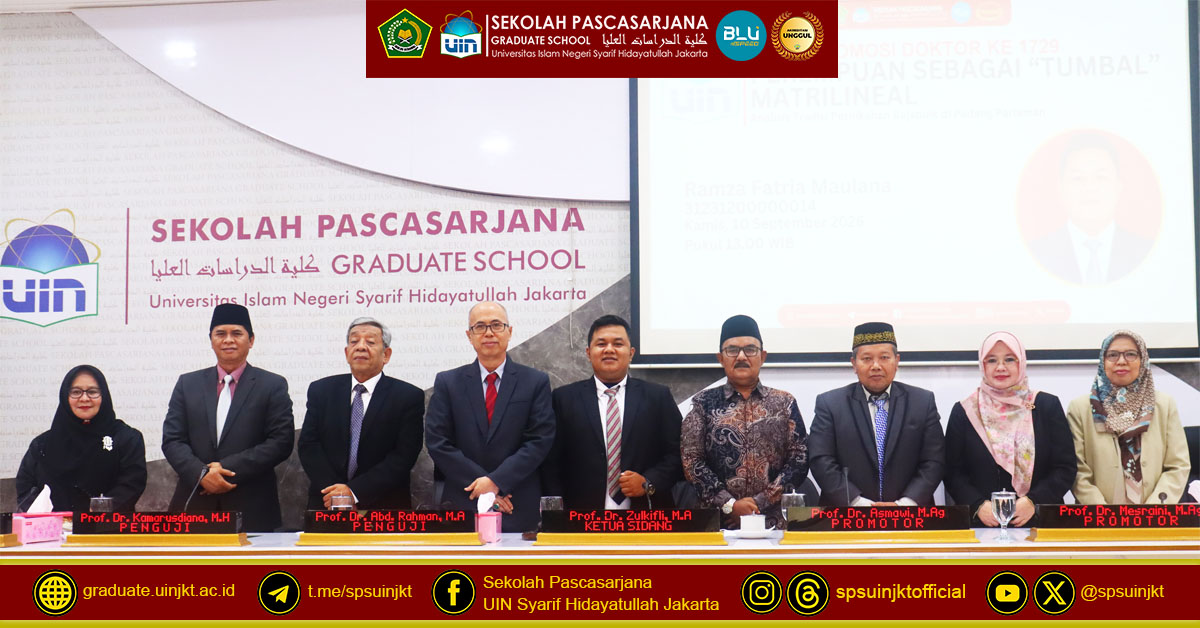
Ramza Fatria Maulana's Doctoral Promotion Exam, Woman as a Matrilineal "Tumbal"
Auditorium of Prof. Dr. Suwito, MA SPs UIN Jakarta, SPs NEWS – The Graduate School (SPs) of UIN Syarif Hidayatullah Jakarta held the 1729th Doctoral Promotion Exam in the Auditorium Room of Prof. Dr. Suwito, MA Graduate School on Thursday, September 10, 2026 with promovendus Ramza Fatria Maulana.
Ramza is a student of the Doctoral program in Islamic Studies with a concentration in Sharia. His dissertation is titled "Women as Matrilineal "Tumbal": An Analysis of the Bajapuik Marriage Tradition in Padang Pariaman".
This dissertation focuses on the phenomenon of bajapuik marriage in Nagari Tandikat. The research dissects how matrilineal customs, Islamic teachings, modernization currents, and gender relations negotiate and clash in a social arena.
Ramza directs her research focus on the process of formation and dynamics of the bajapuik tradition, the position and agency of women when dealing with symbolic violence, to the influence of the intersection of customs, sharia, and modernity on the power structure in marriage.
To skin this phenomenon, this qualitative research based on field studies relies on the analysis knife of Pierre Bourdieu's sociology. Key concepts such as habitus, domain, capital, symbolic power, and symbolic violence are used to read the patterns of inter-actors' relationships.
Field data collection was carried out comprehensively through in-depth interviews, observations, documentation, and targeted group discussions (FGD). Various elements of the Nagari Tandikat community were involved, ranging from niniak mamak, bundo kanduang, traditional leaders, community leaders, academics, cultural experts, to local residents. The collected data was then analyzed interactively through the condensation stage, data presentation, and conclusion drawn.
The results of the study revealed that the bajapuik tradition was formed gradually from the meeting point of the matrilineal system, Islam, social mobility, and the encouragement to maintain the dignity of the race. Interestingly, modernization does not necessarily erode this tradition. The current of the times has shifted the value standards of the prospective groom (marapulai) from what was originally assessed based on traditional titles and descendants, now shifting to the level of education, profession, income, and achievement.
This shift makes japuik money a means of converting economic capital in order to achieve family honor. But on the other hand, this mechanism has the potential to give birth to symbolic violence that burdens women and their families.
Despite being under pressure from the customary structure, this study emphasizes that women are not just passive objects in marriage transactions. They are present as active subjects who participate in negotiating customary rules through the selection of spouses, family deliberations, nominal restrictions on japuik money, simplification of processions, and reinterpreting japuik money as initial capital to build a household. Nevertheless, this form of women's agency still works from within the customary structure, so its character tends to be relational and ambivalent.
From the perspective of Islamic law, the intersection between matrilineal customs, Islam, and modernity places this tradition as an arena for legal and power negotiations. The practice of bajapuik can basically be categorized as al-ʿ urf al-ṣaḥīḥ (legitimate customs) as long as it is not colored by coercion, does not cause harm, and still upholds the principles of justice and benefit.
Therefore, so that this tradition does not continue to reproduce gender inequality, it is necessary to reconstruct meaning, strengthen the voice space for women, transparency, and the arrangement of customary authorities. This step is important so that bajapuik continues to survive as a fair cultural identity.
Academically, Ramza's findings strengthen Maihasni's dissertation on the ever-changing and negotiated nature of the bajapuik tradition , while supporting Hadler's research on the flexibility of the Minangkabau matrilineal customs. However, this dissertation makes a new contribution by providing a critical correction through the lens of gender: that customary negotiations with Islam and modernity do not automatically produce justice, because behind them are still asymmetrical power relations, economic burdens, and symbolic violence against women.
Ramza successfully defended his dissertation under the guidance of Prof. Dr. Asmawi, M.Ag and Prof. Dr. Mesraini, M.Ag, and was tested in front of a board of examiners consisting of Prof. Dr. Zulkifli, MA, Prof. Dr. Asmawi, M.Ag, Prof. Dr. Mesraini, M.Ag, Prof. Dr. Kamarusdiana, MH, Prof. Dr. H. Abd. Rahman, MA, Prof. Dr. Ratna Sari Dewi, M.Pd.
After paying attention to the writing of the dissertation, the comments of the examiner team and the answers of the promovendus, the examiner team determined that Ramza graduated with the title of Very Satisfactory. Ramza Fatria Maulana is the 1729th Doctor in the field of Islamic Studies, the doctoral program of the Graduate School of UIN Syarif Hidayatullah Jakarta. (Jay A)