
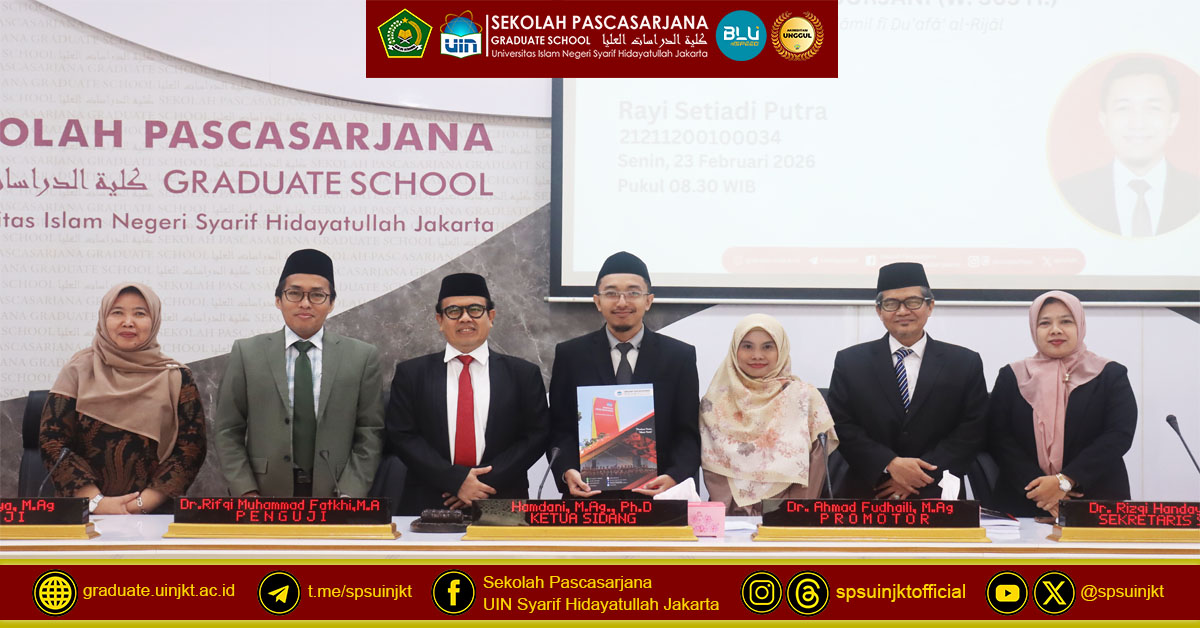
Rayi Setiadi Putra Thesis Test: The Concept of Matan Criticism in the View of Ibn 'Adī al-Jurjānī in Kitab al-Kāmil fī Ḍu'afā' al-Rijāl
Auditorium of Prof. Dr. Suwito, MA SPs UIN Jakarta, SPs NEWS - The Graduate School (SPs) of UIN Syarif Hidayatullah Jakarta held the 2804th Thesis Exam at the Auditorium Room of Prof. Dr. Suwito, MA SPs UIN Jakarta on Monday, February 23, 2026 with candidate Rayi Setiadi Putra.
Rayi is a student of the Master of Islamic Studies program with a concentration in Hadith and Prophetic Tradition. His thesis was entitled "The Concept of Eye Criticism in the View of Ibn 'Adī al-Jurjānī (d. 365 H.) in Kitab al-Kāmil fī Ḍu'afā' al-Rijāl".
Rayi explained that the main purpose of his research was to analyze how Ibn 'Adī al-Jurjānī conceptualized the criticism of hadith texts (matan). Although the book of al-Kāmil is an encyclopedia of problematic narrators, Rayi found that criticism of the quality of hadith editorial was actually a vital instrument in it.
This study specifically examines the use of the terms al-jarh used by Ibn 'Adī. Rayi examines how these technical terms not only target the personal character of the narrator, but also have a strong relevance to the defects or irregularities of the hadith texts they convey.
The focus of the research is directed at the organic relationship between the credibility of the narrator and the quality of the matan. Through dissecting certain narrator cases, Rayi succeeded in formulating a methodology of matan criticism that turned out to be fully integrated with sanad (transmission chain) criticism.
Rayi uses a qualitative method based on library research with a descriptive-comparative-analytical model. He not only uses the conventional hadith science approach, but also combines linguistic analysis based on word structure and a strict historical approach.
The primary source of this research is the book Al-Kāmil itself, supported by various classical and contemporary hadith criticism literature as a secondary source. This multidisciplinary approach allowed Rayi to see the hidden patterns in Ibn 'Adī's arguments.
The findings of this study are very significant for the academic world. Rayi proves that Ibn 'Adī never separated the narrator's personal judgment from the quality of his narration. For him, the history of a narrator is a direct reflection of his integrity and accuracy.
Rayi formulated four main indicators of eye criticism in Ibn 'Adī's thought. The first is the conformity of the hadith with the lafz al-nubuwwah (prophetic language style), and the second is the proportionality of the elements of al-thawab wa al-'iqab (reward and punishment) contained in it.
The third indicator involves the harmony of the text with the Qur'an, other authentic hadiths, as well as established historical facts. Finally, Rayi emphasized the absolute connection between the oddity of matan and doubts about the credibility of the sanad chain that brought it.
The most interesting thing about this thesis is its boldness to refute the claims of skeptical orientalists such as Ignaz Goldziher and Gustav Weil. These orientalists have long alleged that classical hadith scholars are only obsessed with the formality of sanad and ignore criticism of substance or text.
Rayi argues that the tradition of hadith criticism since the earliest times, especially in the 4th century Hijri, has involved systematic attention to matan. The use of terms such as munkar al-hadith, batil, to la yushbihhu hadith al-thiqat (does not resemble the hadith of a trusted narrator) is authentic evidence of the existence of a textual feasibility test.
This research also provides a clear distinction compared to previous studies, such as the work of Zuhayr 'Uthman 'Ali Nur (1989). If previous research focused more on the structure of the book and the methodology of the assessment of narrators, Rayi actually highlighted the dimension of eye criticism as an inseparable part.
Through these findings, Rayi emphasized that the practice of classical hadith criticism remains very relevant to be developed in the contemporary era. The verification model that Ibn 'Adī showed could be a strong foundation in preserving the authenticity of Islamic teachings from distortion of information in the future.
Rayi successfully defended his thesis under the guidance of Dr. Ahmad Fudhaili, M.Ag, and was tested in front of a board of examiners consisting of Hamdani, M.Ag, Ph.D, Dr. Ahmad Fudhaili, M.Ag, Dr. Rifqi Muhammad Fatkhi, MA, Dr. Atiyatul Ulya, M.Ag.
After paying attention to the thesis writing, the comments of the examiner team and the candidate's answers, the examiner team determined that Rayi Setiadi Putra graduated with the title of Very Satisfactory. Rayi Setiadi Putra is the 2804th Master in the field of Islamic Studies, in the Master's program of the Graduate School of UIN Syarif Hidayatullah Jakarta. (JA)