
Refky Fielnanda Doctoral Promotion Exam, Contract Transparency and Spiritual Services Become the Main Key to Sharia Bank Customer Loyalty in Jambi
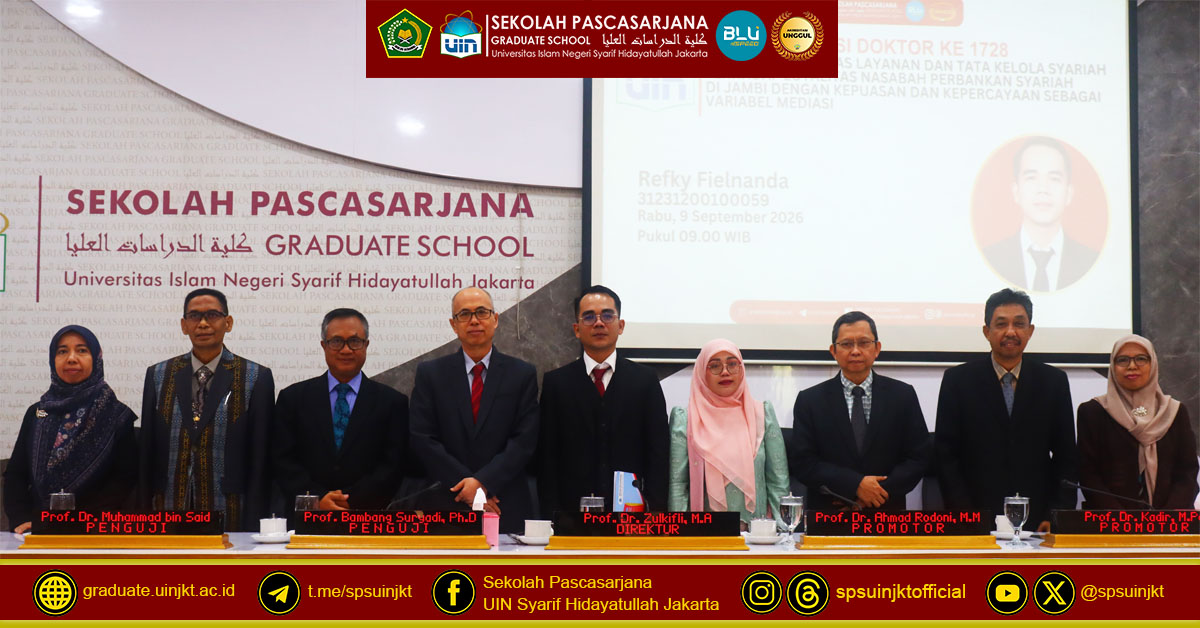
Auditorium of Prof. Dr. Suwito, MA SPs UIN Jakarta, SP NEWS – The Graduate School (SPs) of UIN Syarif Hidayatullah Jakarta held the 1728th Doctoral Promotion Exam in the Auditorium Room of Prof. Dr. Suwito, MA Graduate School on Wednesday, September 9, 2026 with promovendus Refky Fielnanda.
Refky is a student of the Doctoral program in Islamic Studies with a concentration in Sharia Banking and Finance Management. His dissertation is titled "The Influence of Sharia Service Quality and Governance on Sharia Banking Customer Loyalty in Jambi with Satisfaction and Trust as Mediation Variables".
This research departs from field facts regarding the penetration of Islamic banking in Jambi Province which is still at 5.35 percent of total banking assets. In fact, as many as 94.98 percent of the population in the region are Muslim. This inequality indicates that the growth of the national Islamic banking industry has not been fully reflected in the regions, as well as indicating that active customer loyalty has not developed optimally to encourage organic growth.
In order to answer this problem, this study focuses on developing and testing an integrated structural model related to the influence of service quality and sharia governance on the loyalty of Bank Syariah Indonesia (BSI) customers in Jambi Province. This testing process involves satisfaction and trust variables as mediators to see which factors are the most dominant in binding the loyalty of the local Muslim community.
The method used is explanatory sequential mixed methods with three layers of comprehensive data. The quantitative stage involved 213 active BSI customers who were analyzed using Partial Least Squares Structural Equation Modeling (PLS-SEM). The data was then deepened through a qualitative Interpretative Phenomenological Analysis (IPA) approach to eight loyal customer informants, and strengthened by triangulation of sources with the management of BSI Jambi Branch, OJK Jambi Regional Office, academics, and religious leaders.
The results of the quantitative analysis revealed that the quality of service and sharia governance had a positive and significant effect on customer satisfaction, trust, and loyalty. Interestingly, the statistical findings prove that the trust variable plays a much more dominant role as a mediator than just customer satisfaction.
The qualitative side of the research emphasizes that customers interpret service quality from an emotional dimension, such as respect as a Muslim and a spiritual dimension in the form of the belief that transactions are free from riba, gharar, and maysir which brings inner peace (ṭuma'nīnah). On the other hand, sharia governance is no longer seen as limited to administrative compliance, but is judged from the transparency of the contract and the activeness of the Sharia Supervisory Board (DPS) as the highest foundation of trust.
Confirmation from BSI and OJK through verified macro data also strengthens this finding. The perspective of academics and religious leaders also affirms the same thing: the loyalty of Islamic bank customers is basically a conditional mandate. This attitude grows naturally from the combination of functional service quality and concrete sharia integrity, so it demands consistent proof from financial institutions.
Theoretically, Refky Fielnanda's research strengthens the Commitment-Trust Theory of Morgan & Hunt (1994) and Tegambwage & Kasoga (2022) which place trust as the core of forming loyalty. This finding also limits the applicability of Oliver's (1980) and Jawaid et al. (2023) Expectation-Confirmation Theory because in religious societies, functional satisfaction is no longer the main path. The addition of the ṭuma'nīnah emik construct emphasizes that true sharia customer loyalty is firmly rooted in the integrity of religious values.
Refky successfully defended his dissertation under the guidance of Prof. Dr. Ahmad Rodoni, MM and Prof. Dr. Kadir, M.Pd, and was tested in front of a board of examiners consisting of Prof. Dr. Zulkifli, MA, Prof. Dr. Ahmad Rodoni, MM, Prof. Dr. Kadir, M.Pd, Prof. Dr. Muhammad Bin Said, Prof. Nur Hidayah, S.Ag, SE, MA, MA, Ph.D, Prof. Bambang Suryadi, Ph.D.
After paying attention to the writing of the dissertation, the comments of the examiner team and the answers of the examiner, the examiner team determined that Refky graduated with the predicate of Cum Laude. Refky Fielnanda is the 1728th Doctor in the field of Islamic Studies, the doctoral program of the Graduate School of UIN Syarif Hidayatullah Jakarta. (Jay A)