
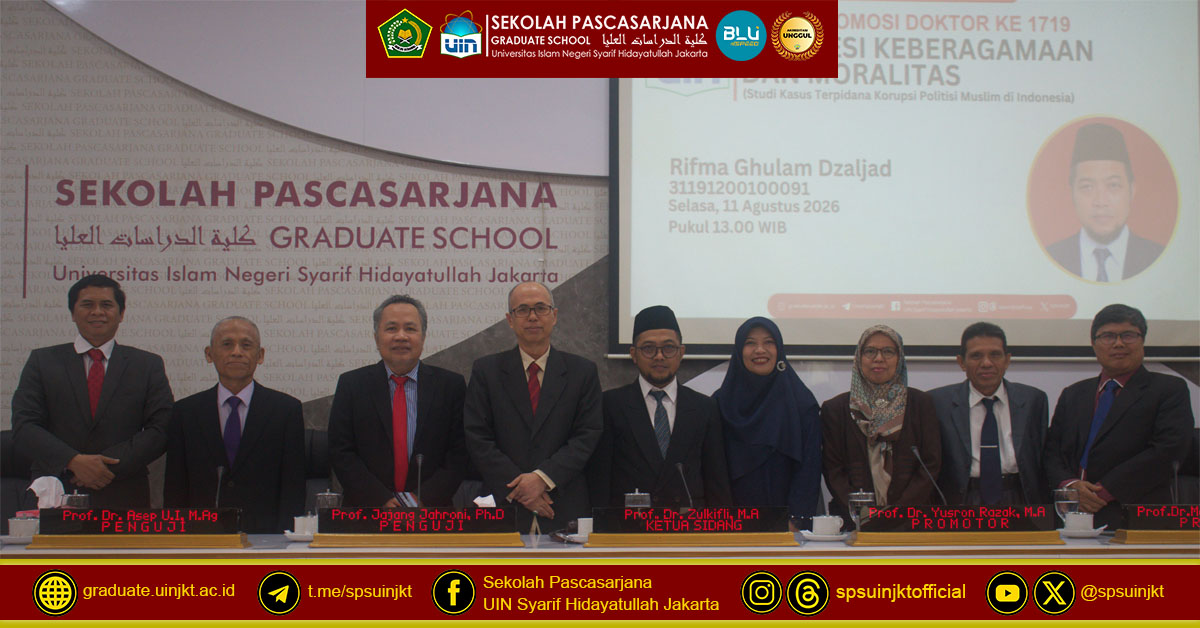
Rifma Ghulam Dzaljad's Doctoral Promotion Exam, Corruption and the Paradox of Religiosity
Auditorium of Prof. Dr. Suwito, MA SPs UIN Jakarta, SPs NEWS – The Graduate School (SPs) of UIN Syarif Hidayatullah Jakarta held the 1719th Doctoral Promotion Exam in the Auditorium Room of Prof. Dr. Suwito, MA Graduate School on Tuesday, August 11, 2026 with promovendus Rifma Ghulam Dzaljad.
Ghulam is a student of the Doctoral program in Islamic Studies with a concentration in Anthropology and Sociology of Religion. His dissertation is entitled "Expression of Religion and Morality (Case Study of Corruption Convicts of Muslim Politicians in Indonesia)".
This research departs from a bitter and paradoxical reality that surrounds the national political scene: the rise of Muslim politicians with strong religious backgrounds who are actually entangled in corruption cases. This discrepancy raises fundamental questions about the extent of the connection between religiosity and anti-corruption morality, as well as marking a significant gap between the normative teachings of religion and the social practices of corrupt actors.
In order to answer this puzzle, Ghulam's research aims to analyze the formation of religious expressions and their relationship with the transformation of the morality of Muslim politicians convicted of corruption. The focus of the study is directed at the patterns of social interaction of the subjects, both during the sentence and after the release period in the community.
Using a qualitative-interpretive approach and an emphasis on relationships and case studies, this study dissects the track records of three main figures with the initials AU, AS, and MR. Primary data collection utilizes netnography methods to process digital traces, ranging from plea memorandums, court decision files, media narratives, television shows, to uploads on social media and podcasts.
The digital data is then enriched with secondary data in the form of in-depth interviews with the subjects and related key informants. To ensure the validity of the findings, the researcher applied the source triangulation technique and processed the data simultaneously using the Miles, Huberman, and Saldana analysis frameworks through the stages of data condensation, data presentation, to conclusion drawing and verification.
The results of the study revealed that politicians convicted of corruption constructed their religious experiences through increasing theoretical, practical, and sociological expressions with varying degrees of intensity. The striking differences are especially noticeable in the sociological aspect, where the U.S. subject has successfully transformed his spiritual experience into a religious movement and community.
In the realm of social interaction, this study found three contrasting narrative articulations among the perpetrators. The AU subject consistently maintains the narrative that he or she is a victim of political injustice and criminalization, the MR subject normalizes corruption as a logical consequence of the high-cost political system, while the US subject uses it as a momentum for repentance, confession, and reconstruction of a new moral identity.
These findings confirm that religious expression does not simply function as a spiritual practice, but rather as a symbolic arena where moral values are constructed, negotiated, and communicated to the public. This dynamic process ultimately gave birth to three forms of "negotiable morality": total denial, systemic normalization, and reflective repentance.
The novelty of this research lies in the reconstruction and refinement of Durkheim's (1968) theory of morality which is related to Joachim Wach's (1944) theory of religious expression. This study proves that morality does not fully work as a disciplinary and collective social fact, but rather as the result of rationalization and symbolic negotiation that is vulnerable to neutralization in line with the thinking of Mead (2018) and Goffman (1959).
Ghulam successfully defended his dissertation under the guidance of Prof. Dr. Masri Mansoer, M.Ag, Prof. Dr. Yusron Razak, MA, Dr. Arief Subhan, M.Ag, and was tested in front of a board of examiners consisting of Prof. Dr. Zulkifli, MA, Prof. Dr. Masri Mansoer, M.Ag, Prof. Dr. Yusron Razak, MA, Dr. Arief Subhan, M.Ag, Prof. Dr. Asep Usman Ismail, M.Ag, Prof. Jajang Jahroni, MA, Ph.D, Prof. Dr. Kamarusdiana, MH.
After paying attention to the writing of the dissertation, the comments of the examiner team and the answers of the promovendus, the examiner team determined that Ghulam graduated with the title of Very Satisfactory. Rifma Ghulam Dzaljad is the 1719th Doctor in the field of Islamic Studies, doctoral program of the Graduate School of UIN Syarif Hidayatullah Jakarta. (Jay A)