
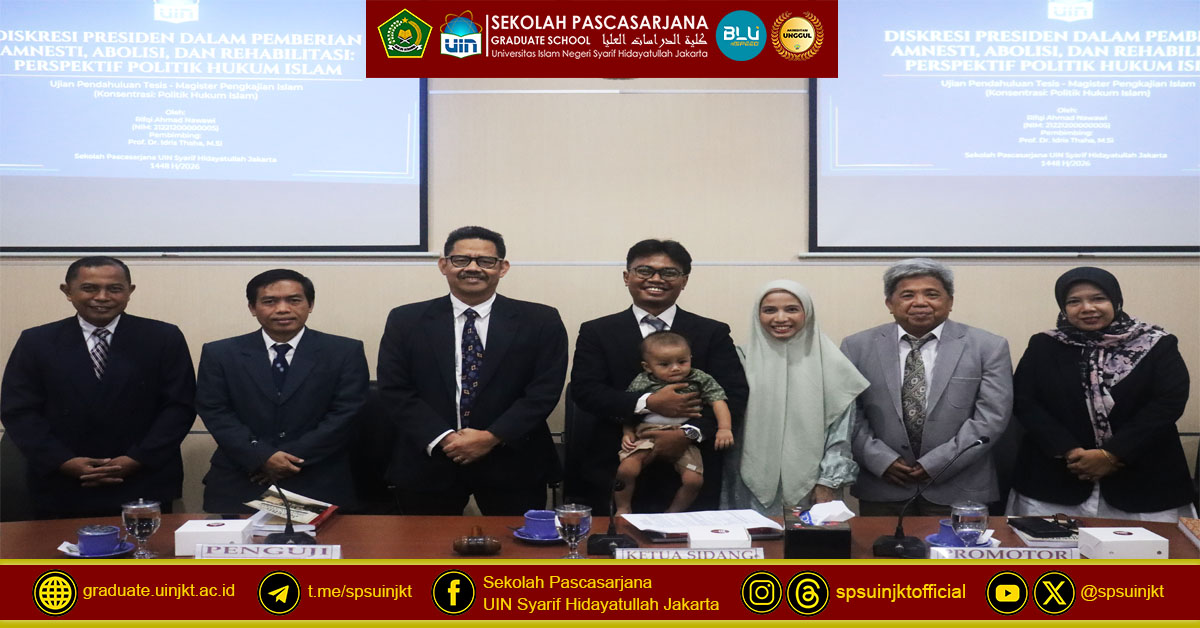
Rifqi Ahmad Nawawi's Thesis Exam, Presidential Discretion in Granting Amnesty, Abolition, and Rehabilitation
Auditorium of Prof. Dr. Suwito, MA SPs UIN Jakarta, SPs NEWS - The Graduate School (SPs) of UIN Syarif Hidayatullah Jakarta held the 2824th Thesis Exam at the SPs Theater Room of UIN Jakarta on Monday, July 27, 2026 with candidate Rifqi Ahmad Nawawi.
Rifqi is a student of the Master of Islamic Studies program with a concentration in Political Science. His thesis is titled "Presidential Discretion in Granting Amnesty, Abolition, and Rehabilitation: A Political Perspective of Islamic Law".
This thesis was born from the empty space of constitutional regulation in Indonesia. Although Article 14 of the 1945 Constitution of the Republic of Indonesia gives full authority to the President, national law does not yet have a standard substantive parameters. The unclear criteria for "state interest", the limit on granting amnesty, and the mechanism for restoring public rights are considered to often cause polemics in law enforcement.
Rifqi's research dissects the polemic by mapping two main trends from previous studies. On the one hand, the President's pardon is seen as a constitutional instrument to maintain national stability and welfare. But on the other hand, experts highlight the high risk of politicization of power if these privileges are exercised without normative boundaries and transparent supervision.
Taking a firm position, this study emphasizes that the legitimacy of a President's discretion should not be measured only from mere formal legality. A pardon policy must be rigorously tested through the parameters of substantive justice, public good, and accountability of power. This is important so that the privileges of the head of state do not shift into a means of impunity for certain groups.
To unravel this problem, a literature-based qualitative normative legal research method is used by combining four approaches at once, namely the statute approach, conceptual approach, historical approach, and case approach). This multidimensional approach is used to dissect the formal legal foundations as well as the reality of political practice on the ground.
This study highlights three concrete case studies that attracted public attention, namely the granting of amnesty to Hasto Kristiyanto, the abolition of Thomas Trikasih Lembong, and rehabilitation for Ira Puspadewi. The three cases are analyzed descriptively-analytically, critically, and comparatively through the analysis of discretionary theory, the state of law, and the concept of fiqh siyāsah.
The results of the analysis show that the President's discretion is a constitutional authority that is not absolute or unlimited. This study emphasizes that every discretionary action must be limited by transparency of reason, proportionality of action, institutional supervision, and direct responsibility to society.
Judging from the object of his study, the granting of amnesty to Hasto Kristiyanto is considered to still leave fundamental problems in the aspect of public justification. Meanwhile, the case of abolitionist Thomas Trikasih Lembong demands a much stricter standard of justification because it intersects directly with the crime of corruption. On the other hand, the rehabilitation of Ira Puspadewi is considered to reflect the character of corrective discretion to restore individual rights.
This research also emphasizes its novelty compared to previous studies. Unlike the study of Mutiara Fahmi Razali et al. (2022) which focuses on the right of pardon of heads of state, or the studies of Fauzan Hafizh & Khalid (2025) and Lia Rahmawati & Retanisa Rizqi (2025) which focus on the mechanism of checks and balances, Rifqi's research specifically draws this discretion into the realm of Islamic political ethics.
The main idea carried out is the importance of testing the President's discretion in corruption cases through the political perspective of Islamic law because it concerns the rights of the wider community (ḥaqq al-'āmmah). Corruption is considered to hurt the public welfare, so the restoration of the law and the protection of public rights should not be ignored for pragmatic political reasons.
This frame of thought is firmly rooted in the classical traditions of prominent Islamic thinkers such as al-Māwardī, Ibn Taymiyyah, al-Ghazālī, and al-Shāṭibī. The scholars agreed to place power as a mandate (amānah) that must be carried out to uphold justice (al-'adl), realize benefits (maṣlaḥah), and minimize the potential for damage (mafsadah) in society.
Rifqi successfully defended his thesis under the guidance of Prof. Dr. Idris Thaha, M.Si, and was tested in front of a board of examiners consisting of Prof. Dr. Yusuf Rahman, MA, Prof. Dr. Idris Thaha, M.Si, Prof. Dr. A. Bakir Ihsan, M.Si, Dr. Agus Nugraha, MA.
After paying attention to the thesis writing, the comments of the examiner team and the candidate's answers, the examiner team determined that Rifqi Ahmad Nawawi graduated with the predicate of Very Satisfactory. Rifqi Ahmad Nawawi is the 2824th Master in the field of Islamic Studies, in the Master's program of the Graduate School of UIN Syarif Hidayatullah Jakarta. (Jay A)