
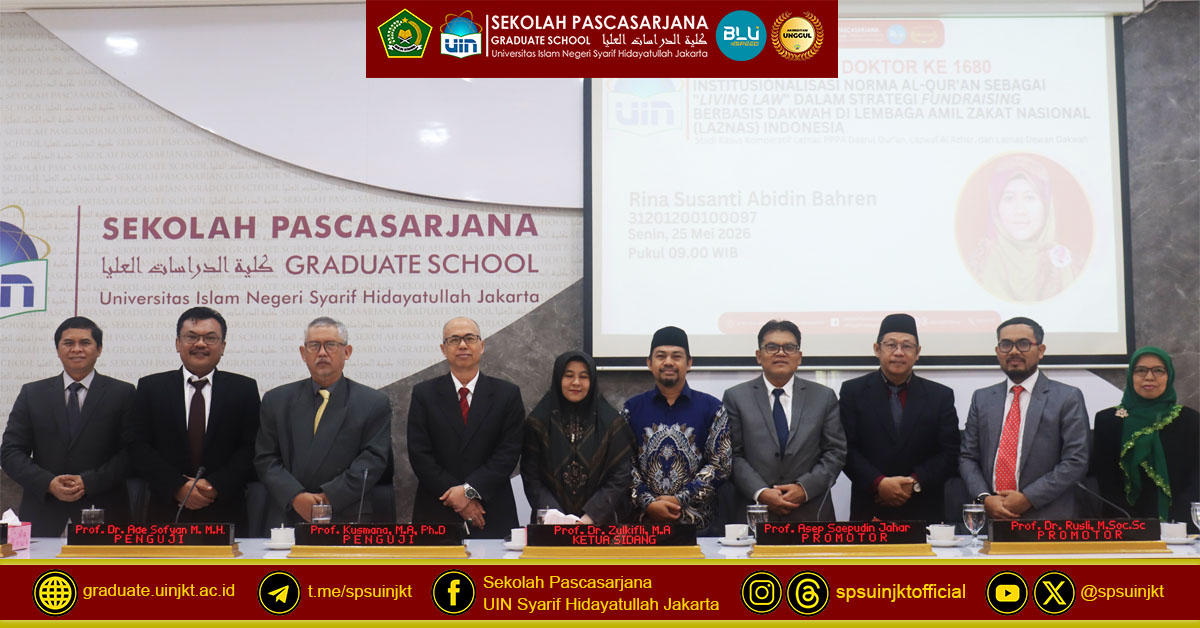
Rina Susanti Abidin Bahren's Doctoral Promotion Exam, Institutionalization of Qur'an Norms as 'Living Law' in Da'wah-Based Fundraising Strategies
Auditorium Prof. Dr. Suwito, MA SPs UIN Jakarta, SP NEWS – The Graduate School (SPs) of UIN Syarif Hidayatullah Jakarta held the 1680th Doctoral Promotion Exam in the Auditorium Room of Prof. Dr. Suwito, MA on Monday, May 25, 2026 with promovenda Rina Susanti Abidin Bahren.
Rina is a student of the Doctoral program in Islamic Studies with a Concentration in Sharia. His dissertation is entitled "Institutionalization of Qur'anic Norms as 'Living Law' in Da'wah-Based Fundraising Strategy at the National Amil Zakat Institute (Laznas) Indonesia (Comparative Case Study of Laznas PPPA Daarul Qur'an, Lazwaf Al Azhar, and Laznas Da'wah Council)".
This research dissects how religious sacred texts are transformed into living laws and practiced in real life by society through philanthropic institutions.
Specifically, this research aims to analyze the process of institutionalizing the norms of the Qur'an as living law through a da'wah-based fundraising strategy at Laznas in Indonesia. Not only that, Rina also highlighted the legal sociological implications of this phenomenon on the social legitimacy of contemporary Islamic philanthropy, an issue that is very relevant in the midst of the rapid growth of zisko management institutions (zakat, infaq, alms, and waqf) in the country.
The focus of the research is directed at three large Laznas that have unique characters and typologies. The three are Laznas PPPA Daarul Qur'an, Lazwaf Al Azhar, and Laznas Dewan Dakwah. The selection of these three institutions is considered very strategic because each represents a charismatic, institutional, and ideological model in the Islamic philanthropic governance landscape in Indonesia.
Through a qualitative approach with the paradigm of Islamic legal sociology, Rina designs her research in the form of comparative case studies. Primary and secondary data were explored in depth through one-on-one interview techniques, limited observations in the field, and rigorous analysis of institutional documents. All the information collected was then dissected using thematic and comparative analysis to see the common thread between the parties.
The analytical knife used in this research is rich and multidimensional. Rina combines the concept of living law with institutional theory, organizational culture, and social innovation theory. The uniqueness of this theoretical framework is further enhanced by the integration of the maqāṣid al-sharī'ah approach to assess the extent to which the functioning of the Qur'anic norms permeates governance, work culture, and the practical implementation of da'wah-based fundraising strategies.
The findings of this study confirm that the norms of the Qur'an as a living law do not work uniformly. The operational mechanism of the living law turns out to be very dependent on the institutional logic embraced by each amil zakat institution. These differences in basic characteristics give birth to a unique variety of strategies and social dynamics in the field.
In Laznas PPPA Daarul Qur'an, living law manifests itself in the form of affective charismatic authority. This model has proven to be very effective and powerful in mobilizing public participation and the generosity of the people massively. Nevertheless, Rina gives a critical note that charismatic models like this tend to be vulnerable to norm personalization and face fluctuations in legitimacy if the central figure shifts.
A contrasting model is seen in Lazwaf Al Azhar which represents the face of procedural institutional living law. This institution features very stable, systematic, and administratively accountable governance. However, the biggest challenge of this model is the risk of bureaucratization of values, where rigid formal procedures have the potential to erode the essence of spirituality and the flexibility of da'wah itself.
Meanwhile, Laznas Dewan Dakwah reflects the pattern of communal ideological living law. This institution shows a very strong normative consistency and upholds the idealistic values of the movement. On the weak side, this communal ideological character has limitations in terms of adapting to the dynamics of rapid digitalization and is less responsive in embracing the character of the urban public that tends to be fluid.
As a differentiator from previous academic literature, Rina's research offers an antithesis to philanthropic studies in Southeast Asia and the Middle East. Unlike the research of Abdul Ghafur Don et al. in Malaysia, Muhammad Fuad Matahir in Brunei Darussalam, as well as the study on Qatar Charities which always emphasizes the hegemony of state regulation and administrative compliance, this study empirically proves that the power of formal regulation is not always directly proportional to the success of living law at the grassroots level.
Rina successfully defended her dissertation under the guidance of Prof. Asep Saepudin Jahar, MA, Ph.D, Prof. Dr. Rusli, S.Ag, M.Soc.Sc, and Dr. Imam Sujoko, MA, and was tested in front of a board of examiners consisting of Prof. Dr. Zulkifli, MA, Prof. Asep Saepudin Jahar, MA, Ph.D, Prof. Dr. Rusli, S.Ag, M.Soc.Sc, Dr. Imam Sujoko, MA, Prof. Kusmana, MA, Ph.D, Prof. Dr. Kamarusdiana, MH, Prof. Dr. Ade Sofyan Mulazid, S.Ag, MH.
After paying attention to the writing of the dissertation, the comments of the examiner team and the answers of the promovendus, the examiner team determined that Rina Susanti Abidin Bahren graduated with the title of Very Satisfactory. Rina Susanti Abidin Bahren is the 1680th Doctor in the field of Islamic Studies, doctoral program of the Graduate School of UIN Syarif Hidayatullah Jakarta. (JA)