
Sahlul Fuad Doctoral Promotion Exam, Gated Community Dress Practice in the Production of Urban Middle-Class Muslim Space
Auditorium of Prof. Dr. Suwito, MA SPs UIN Jakarta, SPs NEWS – The Graduate School (SPs) of UIN Syarif Hidayatullah Jakarta held the 1689th Doctoral Promotion Exam in the Auditorium Room of Prof. Dr. Suwito, MA on Tuesday, July 14, 2026 with promovendus Sahlul Fuad.
Sahlul is a student of the Doctoral program in Islamic Studies with a concentration in Anthropology and Sociology of Religion. His dissertation is entitled "Gated Community Dress Practices in the Production of Urban Middle-Class Muslim Space in Suburban Metropolitan Jakarta".
This research departs from a deep curiosity about how middle-class Muslims dress in cluster housing (gated community) on the outskirts of Jakarta is not just an aesthetic or religious matter, but an active instrument that shapes their social space.
Specifically, this study aims to describe and analyze the practice of dressing as a medium of "social space production". Sahlul wants to unravel how a piece of cloth attached to the urban human body is able to create invisible social boundaries, as well as identify what micromechanisms operate it in suburban environments.
To obtain authentic and in-depth data, Sahlul uses a multisite ethnography qualitative approach. He conducted field research in two housing locations, namely Grand Residence and Nusantara Housing. The data collection process is very intimate and time-consuming, namely through participatory observation and in-depth interviews with 11 Muslim families from November 2024 to April 2026.
In dissecting his field findings, Sahlul knits a rich and multidimensional theoretical framework. He marries Henri Lefebvre's theory of space production with Pierre Bourdieu's concept of habitus and symbolic capital. Not only that, he also modified Erving Goffman's theory of social dramaturgy, and enriched it with the perspective of Islamic jurisprudence to see the dimensions of law and ethics in dress.
The results of this study brought a very interesting finding: the practice of dressing turned out to form a structured gradient of space. This space changes systematically and dynamically, ranging from the most private space (inside the house), semi-public space, to sacred space. The production of this social space is actualized through the change of daily clothes, the way residents negotiate territorial boundaries, and the emotional experiences they feel.
Furthermore, Sahlul introduced clothing as a spatial agency, something that has an active power to define space. He formulated the uniqueness of this micro-mechanism into three modes of Portable Space (portable space), namely binary switches, dimmers, and latent circuits. This concept proves that the "social stage" of self-performance can actually be directly attached to the human body, even in the midst of the limitations of domestic space in modern housing.
This finding also breaks down some of the limitations of previous studies. If previous researchers such as Fadwa El Guindi (1999) and Anna J. Secor (2002) only focused on the hijab and women in public spaces, Sahlul's research actually went further. He found that the dress practices of groups of men and children also play an important role shaping the dynamics of domestic spaces in Muslim family environments.
In addition, Sahlul's study corrects El Guindi's assumptions about the ontological unity of clothing-body, and refutes the findings of Vahaji and Hadjiyanni (2009) regarding the limitations of Western-style home architecture. In the field, Sahlul found that women conduct sartorial negotiations with much higher frequency and complexity than men, especially when responding to guest arrivals and maintaining social distancing.
Sahlul contributed a new concept called Portable Space and enriched Goffman's dramaturgy theory through the term body-bound intensification. This concept explains how clothing (as a personal front) can replace the physical function of the room as a marker of the social stage, complete with the introduction of a "transcendent audience" through the spiritual concept of murāqabah (consciousness is watched over by God).
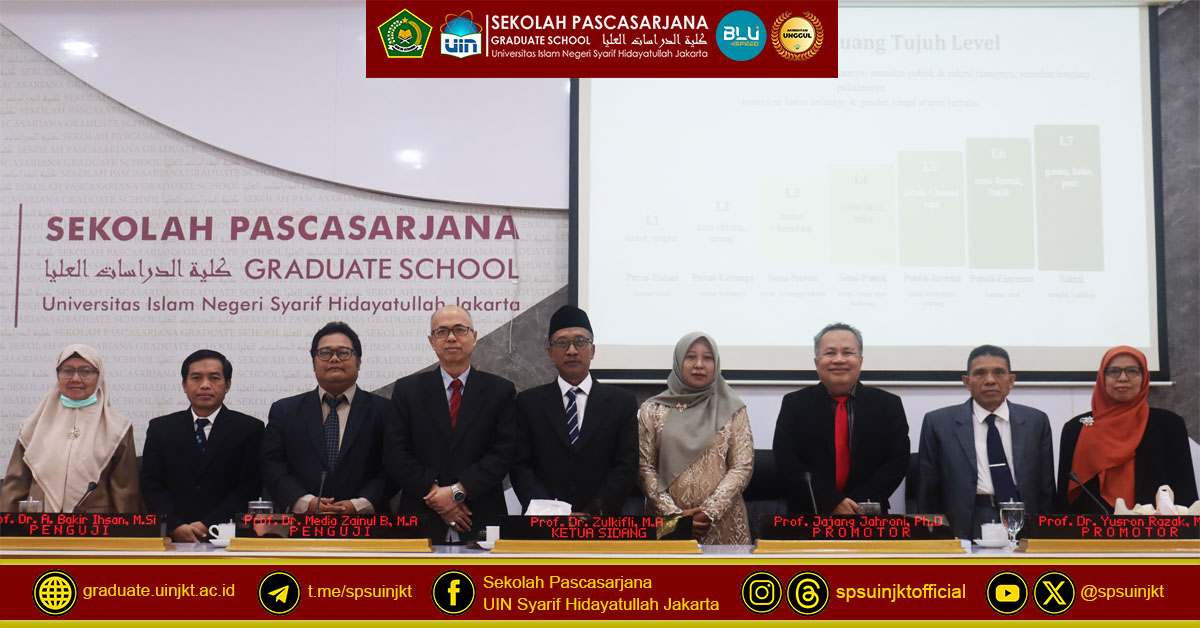
Sahlul successfully defended his dissertation under the guidance of Prof. Dr. Zulkifli, MA, Prof. Dr. Yusron Razak, MA, and Prof. Jajang Jahroni, MA, Ph.D, and was tested in front of a board of examiners consisting of Prof. Dr. Zulkifli, MA, Prof. Dr. Yusron Razak, MA, Prof. Jajang Jahroni, MA, Ph.D, Prof. Dr. Ulfah Fajarini, M.Si, Prof. Dr. Media Zainul Bahri, MA, Prof. Dr. A. Bakir Ihsan, M.Si.
After paying attention to the writing of the dissertation, the comments of the examiner team and the answers of the promovendus, the examiner team determined that Sahlul Fuad graduated with the title of Very Satisfactory. Sahlul Fuad is the 1689th Doctor in the field of Islamic Studies, doctoral program of the Graduate School of UIN Syarif Hidayatullah Jakarta. (Jay A)