
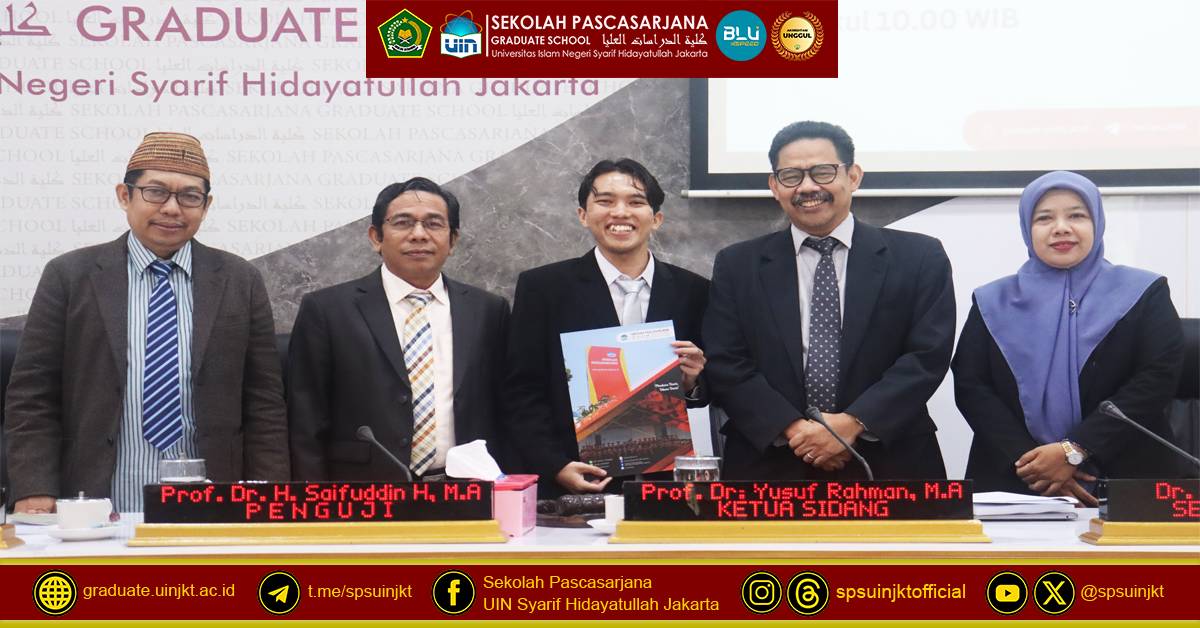
Sihabussalam Thesis Exam: The Implications of Maqāṣidī Ibn 'Āshūr's Tafsīr in the Construction of the Rules of Tarjih Tafsir
Auditorium of Prof. Dr. Suwito, MA SPs UIN Jakarta, SPs NEWS - The Graduate School (SPs) of UIN Syarif Hidayatullah Jakarta held the 2798th Thesis Exam at the Auditorium Room of Prof. Dr. Suwito, MA SPs UIN Jakarta on Thursday, February 5, 2026 with the candidate Sihabussalam.
Syihab is a student of the Master of Islamic Studies program with a Concentration in Tafsir. His thesis is entitled "The Implications of Tafsīr Maqāṣidī Ibn 'Āshūr in the Construction of the Rules of Tarjih Tafsir". This thesis is present as an academic response to the complexity of the discourse of interpretation of the Qur'an in the contemporary era.
This research aims to philosophically dissect the basic structure and arguments of tafsīr maqāṣidī developed by the great Tunisian scholar, Ibn 'Āshūr. His main focus is to discover how the values of the purpose of the shari'a (maqasid) can be internalized into the framework of the rules of tarjih, a mechanism for choosing the strongest opinions among the diversity of interpretations.
Using a qualitative method based on literature studies, Syihab made the work of Tafsīr al-Taḥrir wa al-Tanwir as a primary source. He dissects the text with a descriptive analytical knife as well as a philosophical approach to unearth the critical foundations behind Ibn 'Āshūr's thought.
Interestingly, this thesis integrates the theory of meaning and significance from E.D. Hirsch Jr. This theory is used to analyze how Ibn 'Āshūr's chosen diction and interpretation not only stop at textual meaning, but also reach significance relevant to the context of the times.
The results of the study show that Ibn 'Āshūr's interpretation pattern is a harmonious combination of linguistic depth and maqāṣidī significance. This combination builds a solid conceptual foundation, creating a systematic system of rules, relationships, and principles of scientific disciplines in the world of interpretation.
Shihab argues that the tafsīr of maqāṣidī has the capacity to be the basis for the construction of tarjih. This is verified through the foundation of Ibn 'Āshūr's thought which emphasizes two-way communication between the sacred text and the reader, so that the interpretation remains alive and functional.
Furthermore, this foundation forms an extraordinary significance of tarjih, starting from the formation of a moderate attitude (wasathiyah) to responsiveness to the dynamics of the times. This approach also teaches acceptance of disagreements while maintaining the benefits of legal decision-making.
This thesis succeeds in formulating three main rules in tarjih tafsir. First, the supreme purpose of the Qur'an is the main foundation; second, the tarjih of the verse requires the presence of the basic purpose of the Qur'an; and third, if there is a contradiction of the words, then the decision must be based on a detailed purpose (maqasid khassah).
Emphatically, Shihab rejected the findings of the previous researcher, 'Abīr bint Abdillah al-Na'īm (2015), who said that Ibn 'Āshūr's tarjih tended to be subjective and theological. For him, the philosophy of tafsīr maqāṣidī went beyond just a technical method, because it was an objective worldview.
Despite its philosophical depth, this study emphasizes that tafsīr maqāṣidī is not a rigid subdiscipline or undermines existing traditions. Instead, it has a transformative capacity to present a much more effective, moderate, and inclusive method of interpretation.
The transformation offered does not aim to eradicate the diversity of interpretations. Syihab emphasized that maqasid-based tarjih is actually a dialogical instrument that encourages critical evaluation and continuous interpretation renewal without losing the identity of the text.
This thesis emphasizes that the objectivity of interpretation can be achieved through the maqasid approach without having to close the space for differences. The difference in understanding of the Qur'an is seen as an inherent dynamic, where tarjih is present as a guide for the benefit of mankind.
Sihabussalam successfully defended his thesis under the guidance of Prof. Dr. Yusuf Rahman, MA, and was tested in front of a board of examiners consisting of Prof. Dr. Yusuf Rahman, MA, Prof. Dr. Saifuddin Herlambang, MA and Dr. Abdul Moqsith Ghazali, M.Ag.
After paying attention to the thesis writing, the comments of the examiner team and the candidate's answers, the examiner team determined that Sihabussalam graduated with the title of Very Satisfactory. Sihabussalam is the 2798th Master in the field of Islamic Studies, in the Master's program of the Graduate School of UIN Syarif Hidayatullah Jakarta. (JA)