
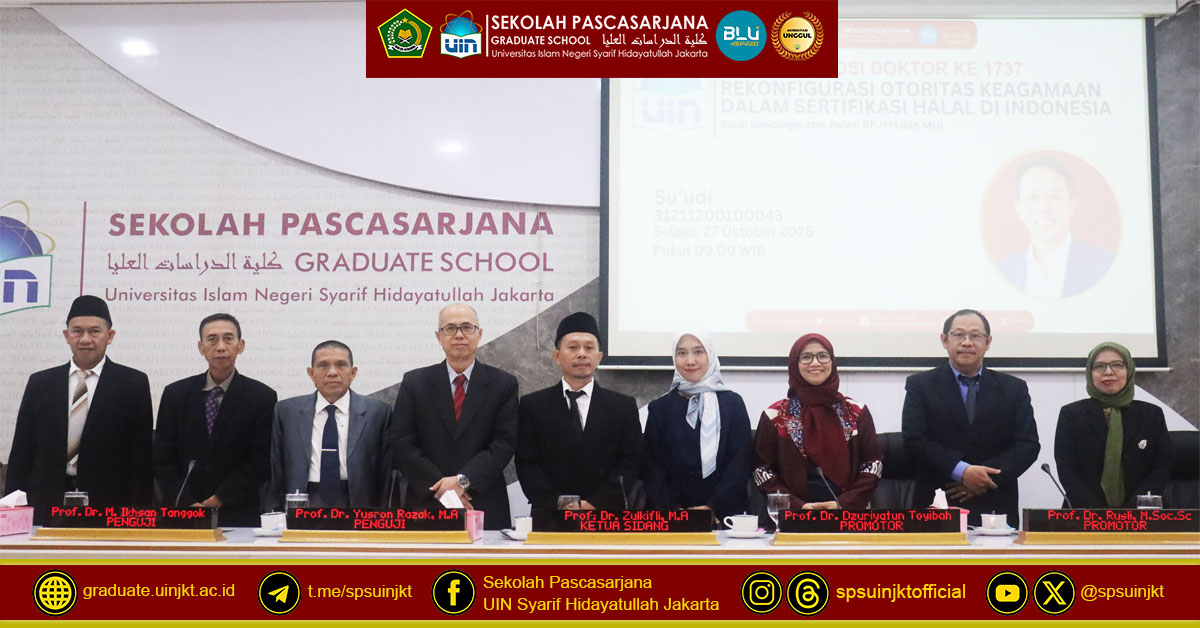
Su'udi Doctoral Promotion Exam, Reconfiguration of Religious Authorities in Halal Certification in Indonesia
Auditorium Prof. Dr. Suwito, MA SPs UIN Jakarta, SPs NEWS – The Graduate School (SPs) of UIN Syarif Hidayatullah Jakarta held the 1737th Doctoral Promotion Exam in the Auditorium Room of Prof. Dr. Suwito, MA Graduate School on Tuesday, October 27, 2026 with the promovendus Su'udi.
Su'udi is a student of the Doctoral program in Islamic Studies with a concentration in Anthropology and Sociology of Religion. His dissertation is titled "Reconfiguration of Religious Authorities in Halal Certification in Indonesia: A Sociological Study on the Relationship between BPJPH and MUI". This title immediately attracted attention because it captured the behind-the-scenes fight between state institutions and religious institutions that have been a reference for the people.
For the general public, the change in the halal product assurance system may be felt simply as a change in administrative rules. After the passage of Law Number 33 of 2014, the halal ecosystem in Indonesia has indeed undergone a complete overhaul. From being voluntary and driven by religious bases, now the system has changed to a full obligation that is directly controlled by the state.
In his research, Su'udi does not stop at the surface of the rule of law. He digs deeper to see how the transition of authority between the Halal Product Assurance Agency (BPJPH) and the Indonesian Ulema Council (MUI) triggers complex social dynamics. This research highlights conflicts of interest, symbolic capital battles, and their direct impact on small business actors and consumers at the grassroots level.
To dissect this phenomenon, Su'udi uses a critical sociological approach. Through qualitative methods, he conducted in-depth interviews with various important parties. Starting from high-ranking officials of BPJPH as representatives of the state elite, MUI central administrators as representatives of religious elites, to Micro, Small and Medium Enterprises (MSMEs) who are the direct objects of the regulation.
From this in-depth observation, one finding was found that was both interesting and intriguing. The process of halal bureaucratization by the state did not run smoothly without obstacles. Instead of running linear, this policy gave birth to the dualism of authority and what Su'udi called an "antagonistic symbiosis" of a relationship that coexisted but full of tension, coupled with internal complexity in the bodies of the two institutions.
On the one hand, the state through BPJPH has indeed succeeded in forcing industry players to comply administratively and legally through strict legal instruments. But on the other hand, the state has not been able to fully seize the spiritual trust of the community. This public trust is still very firmly rooted in the habitus and authority of the ulema owned by the MUI.
The tension between the government's bureaucratic rationality and religious substantive rationality ultimately triggers problems in the field. A phenomenon called halal anxiety or anxiety among consumers has emerged, as well as disorientation of meaning. Not only that, MSME actors also complain about the double burden of compliance that often confuses them in taking care of business licenses.
Seeing these various problems, Su'udi offered a solution so that this crisis of representation does not widen. Halal governance in the future is considered to require the application of a religious co-governance model, where the state and scholars can sit together as truly equal partners.
This dissertation also has a strong novelty compared to previous researches. If previous research is generally stuck on normative legal evaluation or simply measuring the economic benefits of halal labels, Su'udi's work has succeeded in exposing the anatomy of power behind the bureaucratic table. Halal certification has proven to be not just an administrative stamp affair, but an arena for legitimacy battle between state power and religious moral autonomy.
Su'udi successfully defended his dissertation under the guidance of Prof. Dr. Rusli, S.Ag, M.Soc.Sc and Prof. Dr. Dzuriyatun Toyibah, M.Si, MA, and was tested in front of a board of examiners consisting of Prof. Dr. Zulkifli, MA, Prof. Dr. Rusli, S.Ag, M.Soc.Sc, Prof. Dr. Dzuriyatun Toyibah, M.Si, MA, Prof. Dr. M. Ikhsan Tanggok, M.Si, Prof. Dr. Yusron Razak, MA, Prof. Dr. Zubair, M.Ag.
After paying attention to the writing of the dissertation, the comments of the examiner team and the answers of the promovendus, the examiner team determined that Su'udi graduated with the title of Very Satisfactory. Su'udi is the 1737th Doctor in the field of Islamic Studies, the doctoral program of the Graduate School of UIN Syarif Hidayatullah Jakarta. (Jay A)