
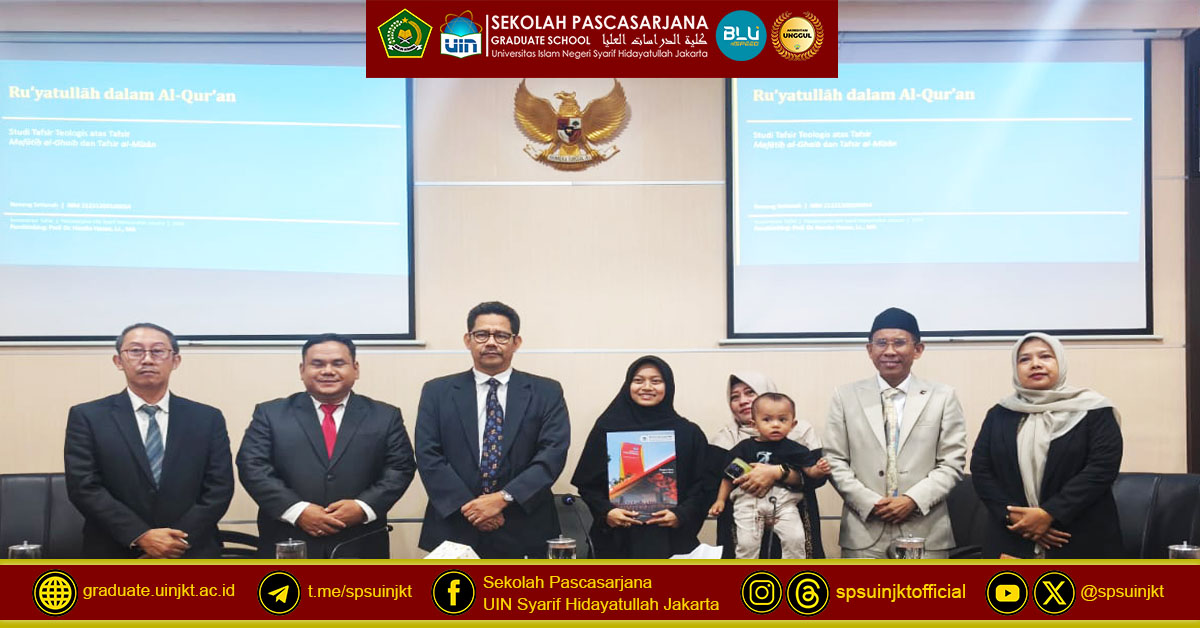
Thesis Exam of Neneng Setianah, Ru'yatullāh in the Qur'an
Auditorium of Prof. Dr. Suwito, MA SPs UIN Jakarta, SPs NEWS - The Graduate School (SPs) of UIN Syarif Hidayatullah Jakarta held the 2838th Thesis Exam at the SPs Theater Room of UIN Jakarta on Monday, August 24, 2026 with candidate Neneng Setianah.
Neneng is a student of the Master of Islamic Studies program with a Concentration in Tafsir, his thesis is entitled "Ru'yatullāh in the Qur'an (Theological Interpretation Study of Tafsir Mafātīḥ al-Ghayb and Tafsir al-Mīzān)".
Through his research, Neneng thoroughly explored the interpretation of the ru'yatullāh verses (seeing Allah) in the Qur'an according to two great mufasir across sects, namely Fakhr al-Dīn al-Rāzī from the Sunni and Muḥammad Ḥusain al-Ṭ abāṭabā'ī from the Shia. This research is focused on analyzing the theological and epistemological arguments behind the differences in views between the two, as well as identifying the common points and differences in a number of key verses, such as QS. al-Qiyāmah: 22-23, QS. al-An'ām: 103, QS. al-Muṭaffifīn: 15, QS. Yūnus: 45, QS. al-A'rāf: 143, and QS. al-Kahfi: 110.
This library-based qualitative study applies a descriptive-comparative analysis method with a historical-philosophical approach. Neneng uses primary references to the book Mafātiḥ al-Ghaib by al-Rāzī and Tafsir al-Mīzān by al-Ṭ abāṭabā'ī. Interestingly, the analysis of interpretations that have the potential to be theologically biased in this study is dissected using Hans-Georg Gadamer's hermeneutics, especially through the concept of fusion of horizons.
The main idea carried out in this thesis emphasizes that the debate on interpretation across sects in the Islamic tradition, which has been considered substantive and mutually deniing, is actually more rooted in methodological and epistemological problems. Both al-Rāzī and al-Ṭ abāṭabāʿī are essentially both committed to preserving the sanctity of Allah (tanzīh) from anthropomorphism or likeness to creatures.
The fundamental difference between the two mufasir lies in the scientific paradigm they use to express the interpretation. Al-Rāzī tends to use an apologetic-dialectical framework of kalam, while al-Ṭ abāṭabāʿī relies on the Sadrian ontological-philosophical paradigm. This proves that the debate on ruʿyatullāh is not merely a clash of beliefs between Sunnis and Shiites, but a reflection of the dynamism of the Islamic intellectual tradition in which two methodological paths can lead to the same theological goal.
Based on an in-depth comparison of arguments, this study concludes that the construction of the interpretation of al-Ṭ abāṭabā'ī shows a stronger level of rationality than that of al-Rāzī. The power of interpretation of al-Ṭ abāṭabā'ī is built on ontological consistency, methodological coherence, and a more complete and comprehensive epistemological consistency.
Thus, the gap between the two is not in the existence or absence of commitment to tanzīh, but in the choice of the scientific paradigm used, namely the theological kalam paradigm in al-Rāzī and the ontological-philosophical paradigm in al-Ṭ abāṭabā'ī.
The findings of this thesis also refute the assessment of Nazahah & Sahidin (2022) which states that the argument of the group rejecting ru'yatullāh is relatively weak. Neneng succeeded in proving that the rejection of al-Ṭ abāṭabā'ī actually stands firmly on a highly rational metaphysical framework, reaffirming that the ru'yatullāh discourse is an epistemological and philosophical debate that enriches the treasures of Islamic thought.
Neneng successfully defended his thesis under the guidance of Prof. Dr. Hamka Hasan, MA, and was tested in front of a board of examiners consisting of Prof. Dr. Yusuf Rahman, MA, Prof. Dr. Hamka Hasan, MA, Prof. Dr. Hasani, MA, Dr. Eva Nugraha, M.Ag.
After paying attention to the thesis writing, the comments of the examiner team and the candidate's answers, the examiner team determined that Neneng graduated with the predicate of Very Satisfactory. Neneng Setianah is the 2838th Master in the field of Islamic Studies, in the Master's program of the Graduate School of UIN Syarif Hidayatullah Jakarta. (Jay A)