
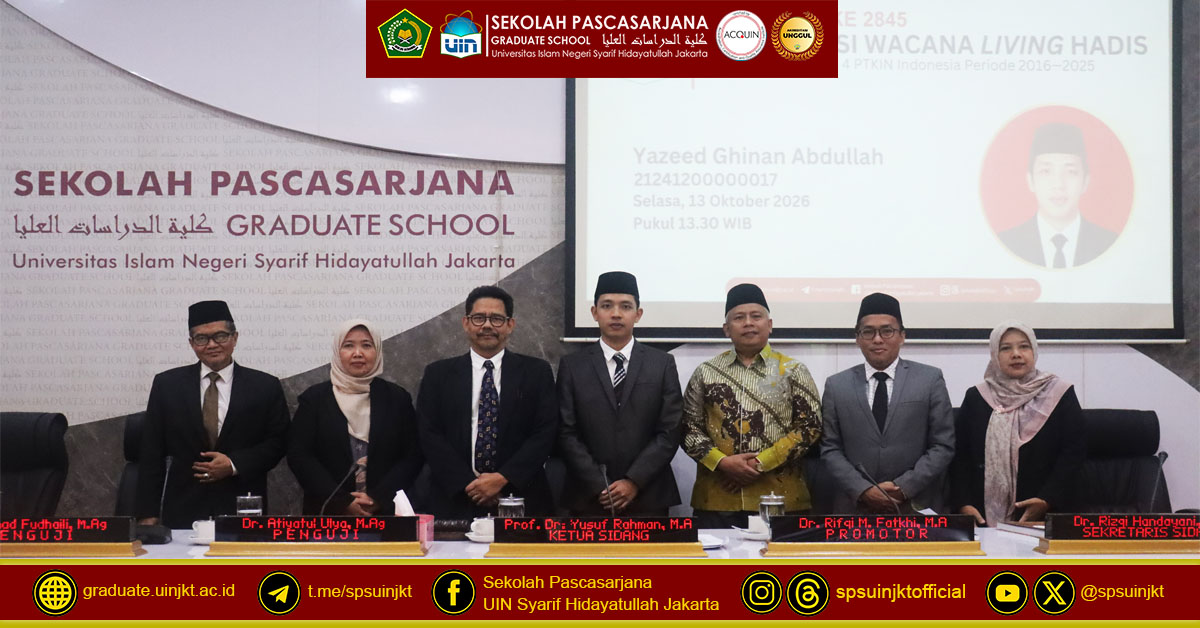
Thesis Examination of Yazeed Ghinan Abdullah: Discourses of Living Hadith Construction in PTKINs
Prof. Dr. Suwito, MA Auditorium Room, SPs UIN Jakarta, BERITA SPs — The Graduate School (SPs) of UIN Syarif Hidayatullah Jakarta held its 2,845th Master’s Thesis Defense at the Prof. Dr. Suwito, MA Auditorium Room, SPs UIN Jakarta on Tuesday, October 13, 2026, featuring candidate Yazeed Ghinan Abdullah.
Yazeed is a student of the Master’s Program in Islamic Studies with a concentration in Quranic Exegesis and Hadith (Tafsir Hadith). His thesis is titled “Construction of the Discourse on Living Hadith (Theses and Dissertations across 4 Indonesian PTKINs, 2016–2025)”.
This research stems from the growing phenomenon of living hadith studies—the study of living hadith traditions practiced within society—which over the past decade has gained a significant portion of curriculum, research, and publications across State Islamic Higher Education Institutions (PTKIN).
Despite its widespread acceptance, Yazeed highlights that the scholarly status of living hadith remains a subject of lively debate. The boundaries of its object of study, its epistemological status, and the methods used to demonstrate the link between hadith texts and social practices in the field are still formulated in diverse ways by researchers. This diversity motivated Yazeed to evaluate the degree of maturity and stability of this research paradigm.
In his study, Yazeed analyzed 25 postgraduate works, consisting of 21 master's theses and 4 doctoral dissertations from four leading Islamic universities: UIN Sunan Kalijaga Yogyakarta, UIN Alauddin Makassar, UIN Syarif Hidayatullah Jakarta, and UIN Walisongo Semarang. All dataset entries were mapped to trace the trajectory of discourse construction between 2016 and 2025.
A text-based qualitative methodology was employed, drawing upon Norman Fairclough’s Critical Discourse Analysis model. This approach dissects three main dimensions simultaneously: text structure, discursive citation practices, and socio-academic practices within the academic environment. The analytical findings were subsequently evaluated using Thomas S. Kuhn’s paradigm theory and Ziauddin Sardar’s framework of Islamic epistemology.
From his inquiry, Yazeed presents the primary argument that the academic ecosystem in PTKINs strongly influences the development direction of living hadith studies. However, attempts to integrate religious sciences and social sciences in this domain frequently encounter limitations. This stems from non-uniform curriculum foundations, scholarly orientations, and institutional visions across campuses.
Ultimately, these conditions give rise to an epistemic imbalance or inequality, particularly regarding the allocation of authority between Hadith studies and the social sciences. This imbalance is most apparent when researchers define the scope of their research objects, design verification procedures, and prove whether a local practice genuinely originates from the cited hadith.
In detail, the study reveals that among all analyzed works, 60 percent of the corpus is heavily dominated by social science approaches, 36 percent successfully operates social science and hadith studies in a balanced and substantive manner, while the remaining 4 percent is dominated purely by traditional Hadith science approaches. This disparity indicates that the capability to identify a tradition is not yet matched by rigorous historical verification of its practice’s transmission and chain of authority (sanad).
Drawing on Thomas Kuhn’s perspectives, Yazeed concludes that while living hadith has consolidated as a popular research tradition, it has not yet achieved a stable disciplinary framework. Applying Ziauddin Sardar’s epistemology, the study re-positions living hadith as an interdisciplinary research model and proposes a relational-verificative model to ensure more measurable and valid proofs.
Through these scholarly findings, Yazeed offers a critical contribution to the existing discourse. His research results correct Aripai’s (2024) view regarding the achievement of "normal science" status in living hadith, while also critiquing Hasbillah’s (2021) perspective, which tends to position living hadith as an independent, standalone branch of hadith science.
Yazeed successfully defended his thesis under the supervision of Dr. Rifqi Muhammad Fatkhi, MA, before a board of examiners consisting of Prof. Dr. Yusuf Rahman, MA; Dr. Rifqi Muhammad Fatkhi, MA; Dr. Ahmad Fudhaili, M.Ag; and Dr. Atiyatul Ulya, M.Ag.
Upon reviewing the thesis writing, the examiners' comments, and the candidate's defense, the board declared that Yazeed passed with the distinction of Sangat Memuaskan (Very Satisfactory/High Honors). Yazeed Ghinan Abdullah becomes the 2,845th Master’s graduate in Islamic Studies at the Graduate School of UIN Syarif Hidayatullah Jakarta. (Jay A)