
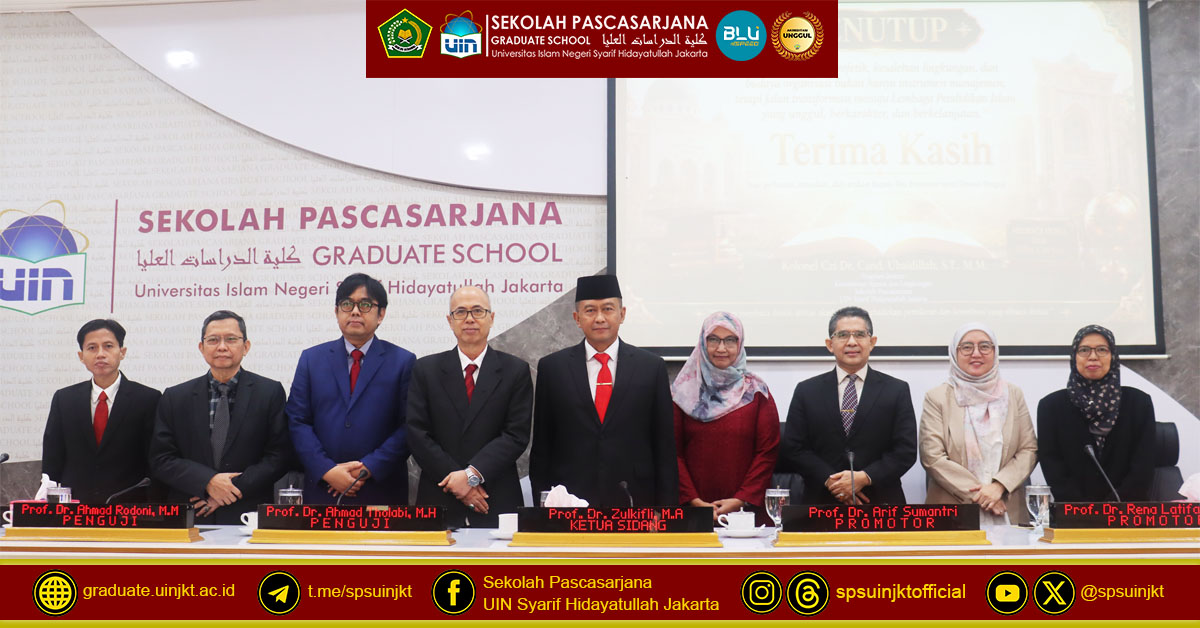
Ubaidillah Doctoral Promotion Test, Integration of Prophetic Leadership and Aswaja: The Key to Overcoming the Ecological Crisis in Islamic Education Boards
Auditorium of Prof. Dr. Suwito, MA SPs UIN Jakarta, SPs NEWS – The Graduate School (SPs) of UIN Syarif Hidayatullah Jakarta held the 1687th Doctoral Promotion Exam in the Auditorium Room of Prof. Dr. Suwito, MA on Monday, July 13, 2026 with the promovendus Ubaidillah.
Ubaidillah is a student of the Doctoral program in Islamic Studies with a concentration in Religion and the Environment. His dissertation is titled "Performance Model of Islamic Education Institutions: The Influence of Transformational Prophetic Leadership, Environmental Piety Training, and Organizational Culture as Mediation.
In his presentation, Ubaidillah highlighted the blurred portrait of the world of education that still lacks environmental concern. Classic problems such as poor sanitation governance, high food waste, and low clean living culture are clear evidence that current educational institutions are not fully able to build sustainable environmental awareness.
Islamic educational institutions are now required to not only score academic achievements, but also to present concrete solutions to the ecological crisis.
The alternative solutions offered in this study are oriented towards sustainable performance improvement. Through the training formula of environmental piety and strengthening organizational culture based on the values of Ahlus Sunnah wal Jama'ah (Aswaja), this research seeks to form a spiritual-ecological awareness that is in harmony with the noble principle of Raḥmatan lil-'Ālamīn.
Academically, this research aims to analyze in depth the influence of Transformational Prophetic Leadership and Environmental Piety Training on the Performance of Islamic Education Institutions (LPI). The main focus is to see the extent to which the important role of organizational culture acts as a mediating or intermediary variable.
In order to comprehensively dissect this phenomenon, Ubaidillah uses a Mixed Method approach with a sequential explanatory design. Quantitative data collection was carried out on 227 teachers as respondents at the Islamic Education Institute of the PB Mosque Foundation. Soedirman, Cijantung, East Jakarta, using research instruments that have been tested for validity and reliability.
The collected data was then analyzed using the Partial Least Squares Structural Equation Modeling (PLS-SEM) method through SmartPLS 4.1.0.9 software. The results of the statistical analysis recorded a very significant number, where the organizational culture variable as a mediator had an R-square adjusted value of 0.754, while the LPI performance variable obtained a value of 0.585.
These findings prove empirically that Transformational Prophetic Leadership and environmental piety training contribute very strongly in forming a healthy organizational culture. In turn, this positive organizational ecosystem is the main driving force in boosting the performance of Islamic educational institutions as a whole.
Interestingly, these quantitative findings are strengthened by in-depth qualitative data. The process of internalizing the values of prophetic leadership, environmental piety, and the breath of Aswaja culture has proven successful in giving birth to an Islamic work culture, high spiritual compliance, and real ecological behavior changes in all institutional citizens.
Theoretically, the results of this doctoral research provide strong support for the leadership theory of Bass and Avolio (1994) and the theory of organizational culture from Schein (2010). Both theories agree on how crucial the role of a leader is in architecting and building culture in an organization.
However, on the other hand, the findings of this research are not entirely in line with the views of Robbins and Judge (2017) who have often emphasized the direct influence of leadership on performance. Through this session, Ubaidillah succeeded in confirming the novelty of his research that improving the performance of Islamic educational institutions is actually much more effective and has a wide impact if mediated by strengthening organizational culture first.
Ubaidillah successfully defended his dissertation under the guidance of Prof. Dr. Arif Sumantri, M.Kes and Prof. Dr. Rena Latifa, M.Psi, Psychologist, and was tested in front of a board of examiners consisting of Prof. Dr. Zulkifli, MA, Prof. Dr. Arif Sumantri, M.Kes, Prof. Dr. Rena Latifa, M.Psi, Psychologist, Prof. Dr. Ahmad Rodoni, MM, Prof. Dr. Ahmad Tholabi Kharlie, S.Ag, SH, MH, MA, Prof. Dr. Fauzan, MA.
After paying attention to the writing of the dissertation, the comments of the examiner team and the answers of the promovendus, the examiner team determined that Ubaidillah graduated with the title of Very Satisfactory. Ubaidillah is the 1687th Doctor in the field of Islamic Studies, doctoral program of the Graduate School of UIN Syarif Hidayatullah Jakarta. (Jay A)