
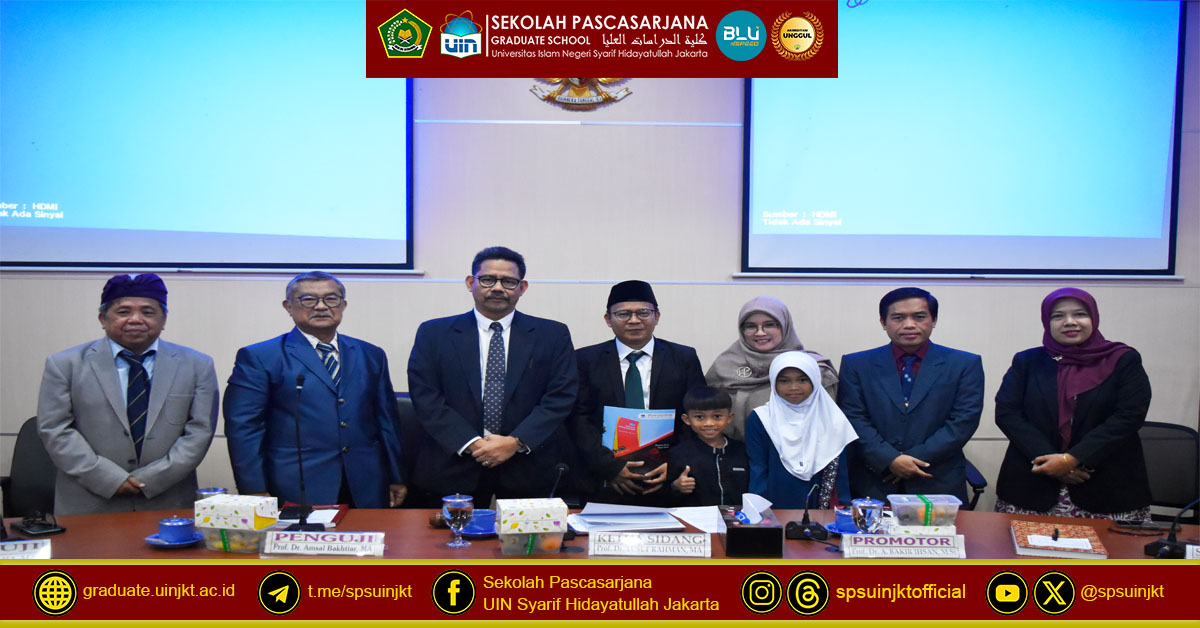
Umam Biladi Kusuma's Thesis Test, Ethics of Power and Social Order in Political Philosophy of Ibn Sīnā
Auditorium of Prof. Dr. Suwito, MA SPs UIN Jakarta, SPs NEWS - The Graduate School (SPs) of UIN Syarif Hidayatullah Jakarta held the 2827th Thesis Exam at the SPs Theater Room of UIN Jakarta on Tuesday, July 28, 2026 with candidate Umam Biladi Kusuma.
Riza is a student of the Master of Islamic Studies program with a Concentration in Interdisciplinary Tafsir. His thesis was entitled "The Ethics of Power and Social Order in Ibn Sīnā's Political Philosophy".
This research was initiated to examine in depth the concept of the ethics of power in the political philosophy of Ibn Sīnā. The fundamental study is highlighted through the three dimensions of his practical philosophy, namely self-management (siyāsat al-nafs), household management (tadbīr al-bayt), and leadership (imāmah). In addition, Umam also explains how the ideal social order is formed through the integration of reason, revelation, and universal law as stated in Kitāb al-Shifā', especially in the section on Ilāhiyyāt.
Using the library research method with a qualitative-textual approach, this study relies on primary data sources from the authentic works of Ibn Sīnā. Among them are Kitāb al-Shifā', Al-Najāt, Kitāb al-Siyāsah, ʿUyūn al-Ḥ ikma, and Fī Aqsām al-ʿ Ulūm al-ʿAqliyyah. Meanwhile, secondary data is absorbed from the thoughts of scholars who study the political philosophy of the veteran philosopher.
The data collection process was carried out through close reading of primary and secondary texts. Furthermore, the data were analyzed using descriptive-analytical and comparative methods through a philosophical-philosophical theology approach. This approach fundamentally places metaphysics as the main foundation in the entire edifice of Ibn Sīnā's political thought.
The results of the study show that Ibn Sīnā's power ethics are hierarchical and gradative. The process begins with self-mastery through the domination of reason over lust, continues to the establishment of the moral stability of the family as the foundation of the social order, and culminates in ideal leadership based on moral reason (al-ʿ aql al-qudsī).
Another important finding of this thesis confirms that the legitimacy of power does not actually rest on coercive force or mere formal authority. Rather, legitimate power is firmly rooted in moral virtues, wisdom, and the ability of a leader to translate divine truth into the laws and dynamics of real social life.
Furthermore, the ideal social order is built through a harmonious synthesis of reason, revelation, and sharia. This integration not only serves to maintain the social order of society, but also actively shapes the moral character of the citizens and directs them towards true justice and happiness (al-saʿādah). In this frame of thought, politics is interpreted as a reflection of the order of the cosmos that connects ethics, law, prophethood, and metaphysics.
This scholarly study explicitly reinforces Derar Ali Bani Yasin's (2023) view of the relationship between prophethood and civil science, and supports James W. Morris's (1992) analysis of the concept of philosopher-prophets. At the same time, Umam's findings also correct Miriam Galston's (1979) interpretation which tends to see Ibn Sīnā's political thought as only a minimalist system.
Through this thesis, Umam succeeded in arguing that the core of Ibn Sīnā's political philosophy does not lie in the theory of the state or the technical mechanisms of power. The essence of this thought lies in the ethics of power which serves as the ontological foundation for the formation of a just social order, so that politics is positioned as a means of perfecting the soul and achieving metaphysical human happiness.
Umam successfully defended his thesis under the guidance of Prof. Dr. A. Bakir Ihsan, M.Si, and was tested in front of a board of examiners consisting of Prof. Dr. Yusuf Rahman, MA, Prof. Dr. A. Bakir Ihsan, M.Si, Prof. Dr. Amsal Bakhtiar, MA, Prof. Dr. Idris Thaha, M.Si.
After paying attention to the thesis writing, the comments of the examiner team and the candidate's answers, the examiner team determined that Umam Biladi Kusuma graduated with the predicate of Very Satisfactory. Umam Biladi Kusuma is the 2827th Master in the field of Islamic Studies, in the Master's program of the Graduate School of UIN Syarif Hidayatullah Jakarta. (Jay A)