
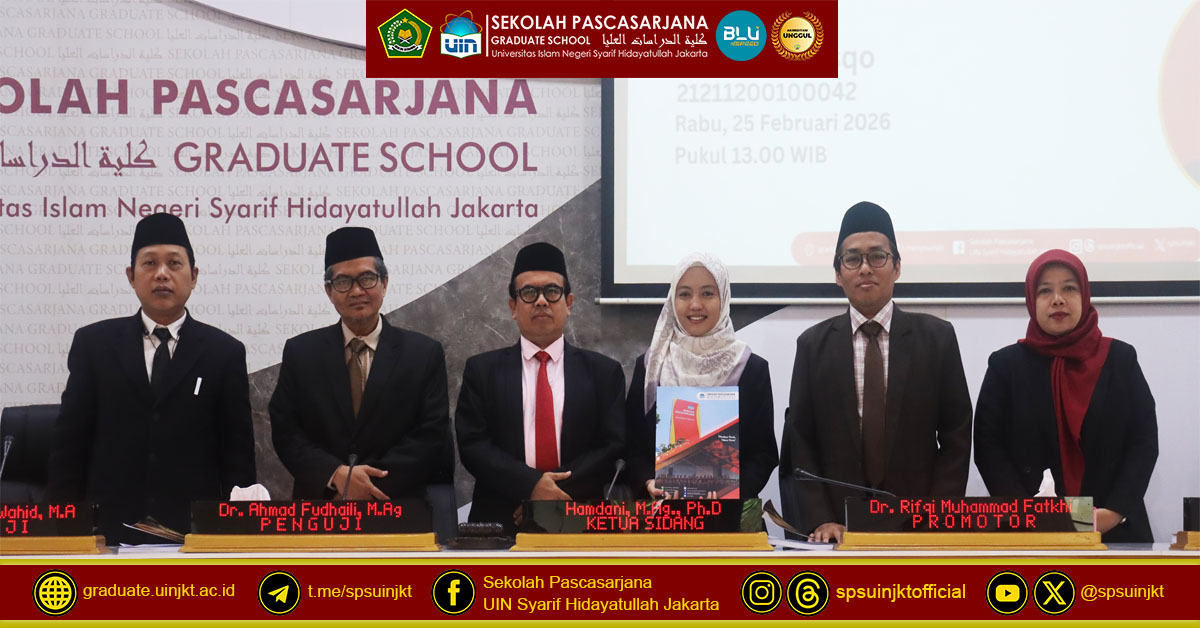
Urwatul Wusqo Thesis Exam: Reconstruction of the Contemporary Meaning of the Hadith on the Prohibition of Body Modification
Auditorium of Prof. Dr. Suwito, MA SPs UIN Jakarta, SPs NEWS - The Graduate School (SPs) of UIN Syarif Hidayatullah Jakarta held the 2809th Thesis Exam at the Auditorium Room of Prof. Dr. Suwito, MA SPs UIN Jakarta on Wednesday, February 25, 2026 with candidate Urwatul Wusqo.
Urwa is a student of the Master of Islamic Studies program with a concentration in Hadith Interpretation. His thesis is entitled "Reconstruction of the Contemporary Meaning of the Hadith on the Prohibition of Body Modification in the Perspective of Hermeneutics and Maqāṣid al-Sharī'ah". This thesis highlights how classical texts respond to the increasingly complex phenomenon of modern lifestyle.
This research departs from academic anxiety about the current rampant practice of body modification. Urwa seeks to review these prohibitory hadiths by tracing socio-historical conditions or asbāb al-wurūd, in order to find a common thread between the meaning of the text in the past and the reality in the present.
Using a qualitative approach with a descriptive-analytical method, Urwa managed to identify 55 hadiths related to body modification. Keywords such as al-Wāshimah (tattoo), al-Nāmiṣah (shaving eyebrows), and al-Wāṣilah (hair connector) became the fulcrum in the elaboration of normative meaning through sharḥ al-ḥadīth.
The main attraction of this research lies in the use of double analysis knives, namely the Double Movement theory of Fazlur Rahman and Maqāṣīd al-Sharīʿah of Jasser Auda. This combination allows the hadith text to be read not only textually, but also contextually and systemically.
Through the theory of Double Movement, Urwa makes regressive movements to understand the historical situation when the hadith appears, then makes progressive movements to attract "ideal-moral" values to the present. This is so that the original message of the hadith is not lost to the times but remains relevant to social dynamics.
Meanwhile, Jasser Auda's approach is used to measure aspects of benefits and ethical principles. Urwa considers that the prohibition in the hadith must be placed in the framework of protecting human dignity, so that its meaning can be an ethical guide that is adaptive to the development of the times.
The main findings of this study confirm that the reconstruction of the meaning of hadith through these two movements succeeded in changing the perception of the text. Hadith is no longer seen as a rigid or rigid normative reference, but as a dynamic ethical guideline in taking actions against the body.
Urwa makes a strong argument that the essence of the ban on body modification is the protection of humans. The goal is to keep individuals away from practices that contain elements of fraud (tadlis), endanger health (dharar), and actions that degrade human dignity.
Furthermore, this research offers a solution to the gap that often occurs between normative hadith studies and contemporary biomedical ethical discourses. The reading model offered is able to bridge the text and context without sacrificing the authority of fundamental sharia values.
The significance of this research can also be seen from its support for the study of Muhammad Mattori (2022). Urwa reinforces the idea that the reactualization of hadith based on Maqāṣīd al-Sharīʿah is an urgent need for the religious understanding of Muslims to be more comprehensive and inclusive.
This thesis concludes that Islamic values can still be upheld in the midst of the current of modernity, as long as the ummah is able to explore ethical spirituality from behind the text. This thesis is expected to be an important reference for academics and practitioners of Islamic law in looking at modern humanitarian issues.
Urwa successfully defended his thesis under the guidance of Dr. Rifqi Muhammad Fatkhi, MA, and was tested in front of a board of examiners consisting of Hamdani, M.Ag, Ph.D, Dr. Rifqi Muhammad Fatkhi, MA, Dr. Ahmad Fudhaili, M.Ag and Dr. Abdul Hakim Wahid, MA.
After paying attention to the thesis writing, the comments of the examiner team and the candidate's answers, the examiner team determined that Urwatul Wusqo graduated with the predicate of Very Satisfactory. Urwatul Wusqo is the 2809th Master in the field of Islamic Studies, in the Master's program of the Graduate School of UIN Syarif Hidayatullah Jakarta. (JA)