
Wahyu Tri Cahyono's Thesis Exam, Maqāṣid al-Sharī'ah's Analysis of Anti-Terrorism Law Number 5 of 2018
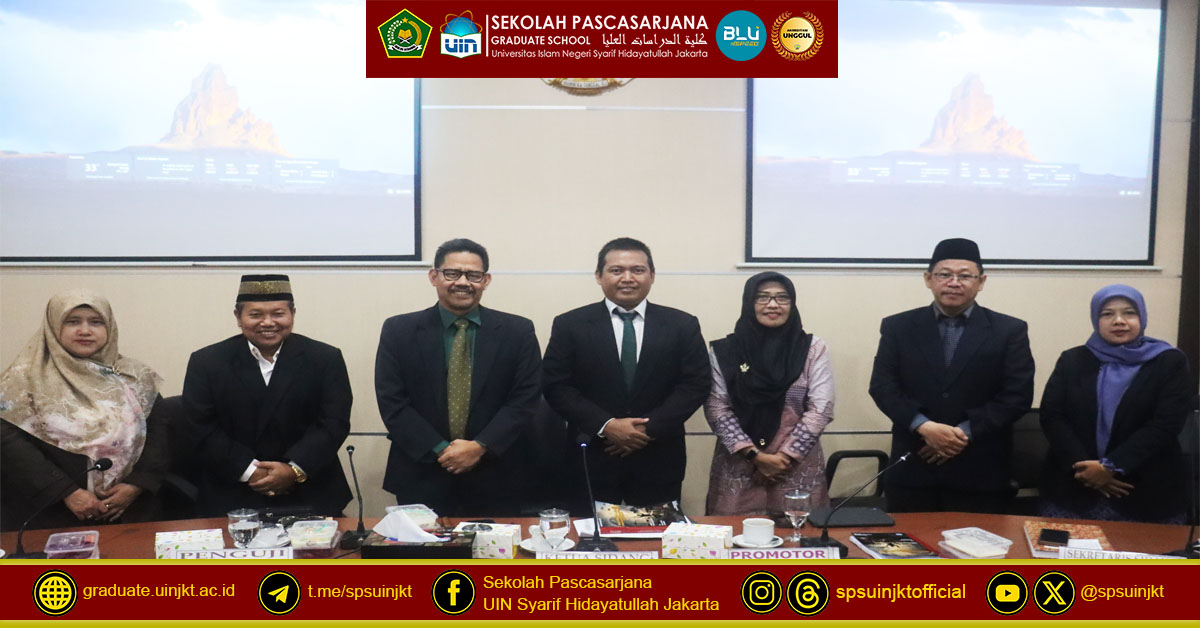
Auditorium of Prof. Dr. Suwito, MA SPs UIN Jakarta, SPs NEWS - The Graduate School (SPs) of UIN Syarif Hidayatullah Jakarta held the 2831st Thesis Exam at the SPs Theater Room of UIN Jakarta on Thursday, July 30, 2026 with candidate Wahyu Tri Cahyono.
Wahyu is a student of the Master of Islamic Studies program with a Concentration in Sharia. His thesis is entitled "Maqāṣid al-Sharī'ah's Analysis of Anti-Terrorism Law Number 5 of 2018".
This research departs from the need to uncover the paradigm behind the Antiterrorism Law No. 5 of 2018 through an interdisciplinary lens. Revelation marries the Theory of Proportionality from the German legal thinker, Robert Alexy, with the concept of maqāṣid al-sharī'ah formulated by the great Tunisian scholar, Ibn 'Āshūr. Using a qualitative method approaching doctrinal library research, this study analyzes related laws through a philosophical-comparative perspective.
In his main argument, Wahyu emphasized that maqāṣid al-sharī'ah , which focuses on efforts to bring benefits and reject harm, is very dynamic and relevant in the hands of jurisprudence. The idea of Islamic law has proven to be able to develop contextually following changes in the social order, even when it intersects with the logic of modern secular legal thought.
Interestingly, this study shows that although positive legal products are largely colored by modern public reason, the framework of Islamic law formulated by classical and contemporary scholars has found a common ground. Both of these traditions of thought are rooted in the spirit of safeguarding and protecting the principles of basic human rights.
The revelation highlights the six main pillars of maqāṣid al-sharī'ah according to Ibn 'Āshūr, namely al-fiṭrah (individual rights), al-ḥ urriyyah (freedom), al-samāḥah (tolerance), al-musāwah (equality), al-'adālah (justice), and niẓām al-ummah (social order). All of these elements are considered to be a vital foundation in balancing the protection of citizens' rights and efforts to maintain national security stability in laws and regulations.
The results of this study also support the academic views of Asmawi et al. (2019) from the perspective of siyāsah shar'iyyah. Although Law No. 5 of 2018 still contains a number of provisions that have the potential to trigger human rights issues and Islamic values that are open to multiple interpretations, these regulations can still be justified for the sake of the wider public interest and political policy considerations of Islamic law (siyāsah shar'iyyah).
On the other hand, Wahyu's findings expressly criticize Yasir Ahmadi's (2017) argument that the lack of detention duration of suspected terrorists is the main obstacle to the disclosure of terrorism networks. Through proportionality and benefit analysis, the addition of immeasurable detention duration has the potential to harm human rights, so that the enforcement of anti-terrorism laws must still run within the corridor of justice and the principle of legal certainty.
Wahyu successfully defended his thesis under the guidance of Prof. Dr. Rusli, S.Ag, M.Soc.Sc, and was tested in front of a board of examiners consisting of Prof. Dr. Yusuf Rahman, MA, Prof. Dr. Rusli, S.Ag, M.Soc.Sc, Prof. Dr. Asmawi, M.Ag and Dr. Masyrofah, M.Si.
After paying attention to the thesis writing, the comments of the examiner team and the candidate's answers, the examiner team determined that Wahyu graduated with the predicate of Very Satisfactory. Wahyu Tri Cahyono is the 2831st Master in the field of Islamic Studies, in the Master's program of the Graduate School of UIN Syarif Hidayatullah Jakarta. (Jay A)