
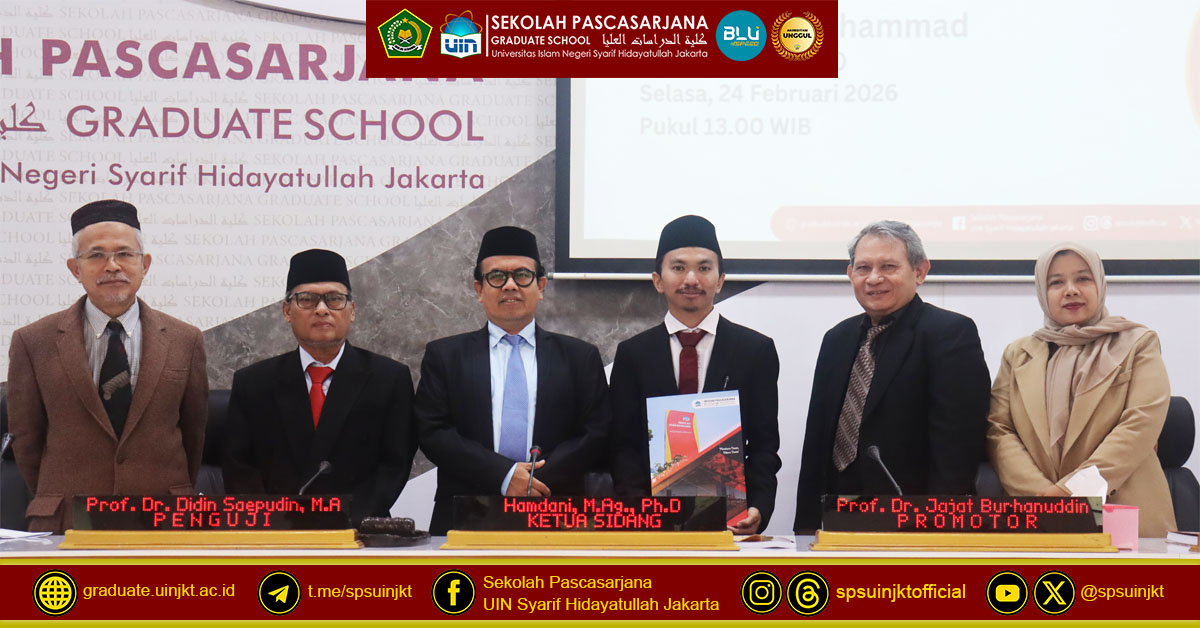
Zufardien Muhammad's Thesis Exam: The Practice of Diplomacy of the Ottoman Turkish Consulate in Batavia in the Context of the Dutch East Indies Colonial (1882—1924)
Auditorium of Prof. Dr. Suwito, MA SPs UIN Jakarta, SPs NEWS - The Graduate School (SPs) of UIN Syarif Hidayatullah Jakarta held the 2807th Thesis Exam at the Auditorium Room of Prof. Dr. Suwito, MA SPs UIN Jakarta on Tuesday, February 24, 2026 with candidate Zufardien Muhammad.
Zufardien is a student of the Master of Islamic Studies program with a concentration in Islamic History and Civilization. His thesis was entitled "The Practice of Diplomacy of the Ottoman Turkish Consulate in Batavia in the Colonial Context of the Dutch East Indies (1882-1924)".
Zufardien presented the findings regarding the diplomatic practices of the Ottoman Turkish Consulate in Batavia during the colonial period of the Dutch East Indies, a crucial period that is rarely explored through the lens of Istanbul archives.
This thesis aims to dissect how the largest Islamic caliphate at that time operated its influence in the Dutch colonies. This research highlights the transformation of the pattern of relations between Ottoman Turkey and the archipelago from an inter-kingdom to a modern, institutionalized diplomatic relationship.
The main focus of this study was to examine the movements of the Ottoman consuls in a very narrow colonial space and closely supervised by Dutch regulations. The consulate in Batavia not only served as an administrative office, but also served as a strategic intermediary between Istanbul, the Muslim community in the archipelago, and the ever-suspicious Dutch colonial authorities.
The main strength of Zufardien's research lies in the methodology of the history of diplomacy based on primary sources. He traced authentic documents from Başbakanlık Osmanlı Arşivi (BOA) in Istanbul, Turkey. Through a historical-contextual reading of these diplomatic archives, the work dynamics and dilemmas of the Ottoman consuls were neatly reconstructed.
The findings of this study bring a surprising new perspective. Contrary to popular assumptions, the Ottoman Turks did not position themselves as a political or military protector for the Muslims of the archipelago. On the contrary, Istanbul presents itself as a modern diplomatic actor that strongly respects international law and maintains geopolitical stability for the sake of good relations with the colonial government.
The birth of the consulate in Batavia marked a paradigm shift in Ottoman political communication. If previously they established relations with local sultanates such as Aceh, in the period 1882–1924 they switched to non-territorial consular diplomacy. This means that the Ottomans chose to operate directly in the nerve center of Dutch power to protect the interests of its citizens and religion.
The consulate's daily diplomatic practice spans a broad spectrum, from political representation, administrative protection for Ottoman citizens, to legal mediation. Although it seemed formal, the consulate also facilitated the social and religious interests of the Muslim community in Batavia within defensive procedural boundaries so as not to provoke an open conflict with the Dutch.
Zufardien argues that the presence of the Ottoman Turks in the late 19th to early 20th centuries was not a form of physical power expansion. The influence of the caliphate was manifested through "symbolic negotiations" and shrewd diplomacy in the midst of the squeeze of colonial power, proving that the power of influence does not always have to be measured by territorial control.
This research also offers novelty by positioning Batavia as the main arena of Ottoman diplomacy in Southeast Asia. If previous researchers such as Reid (1967), Supratman (2016), and Pandawa (2020) have highlighted the issue of Pan-Islamism or the Aceh network, this study provides space for Batavia as a meeting point for complex modern diplomacy.
This academic contribution not only enriched the history of Ottoman Turkish-Nusantara relations, but also provided the public with a new understanding of how a global power managed relations in colonial territories. This thesis trial is proof that the history of Islamic diplomacy in Indonesia still has many interesting sides that need to continue to be explored through international sources.
Zufardien successfully defended his thesis under the guidance of Prof. Dr. Jajat Burhanudin, MA, and was tested in front of a board of examiners consisting of Hamdani, M.Ag, Ph.D, Prof. Dr. Jajat Burhanudin, MA, Prof. Dr. Didin Saepudin, MA, Dr. Fuad Jabali, MA.
After paying attention to the thesis writing, the comments of the examiner team and the candidate's answers, the examiner team determined that Zufardien graduated with the predicate of Very Satisfactory. Zufardien Muhammad is the 2807th Master in the field of Islamic Studies, in the Master's program of the Graduate School of UIN Syarif Hidayatullah Jakarta. (JA)