
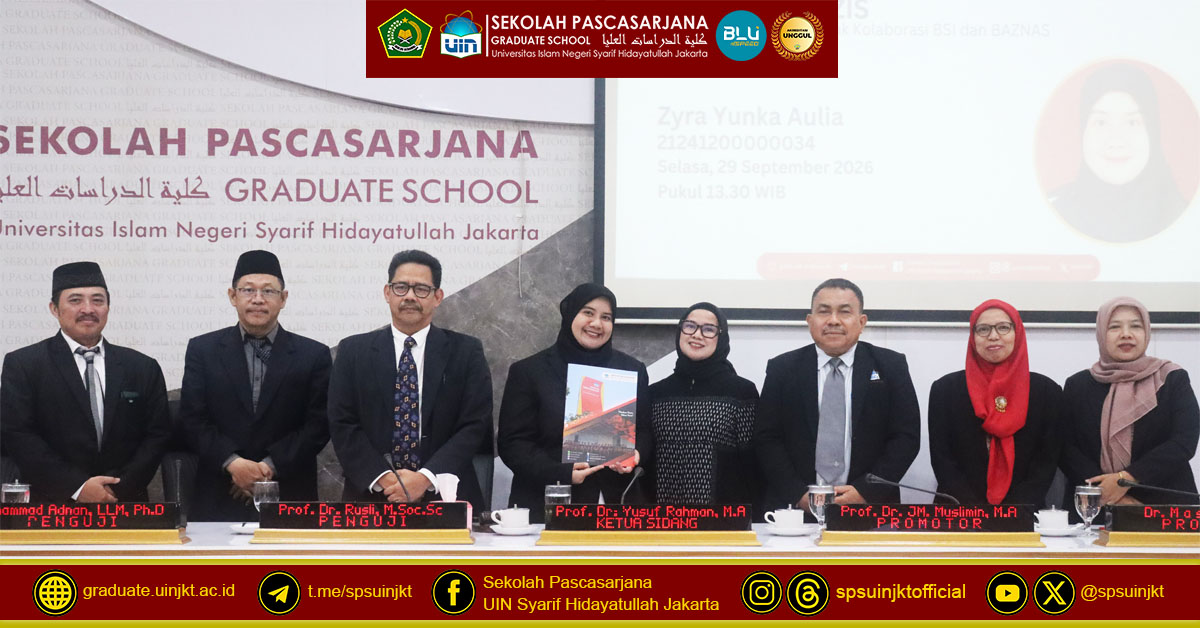
Zyra Yunka Aulia's Thesis Exam, Sharia Financial Inclusion in ZIS: An Analysis of the Impact of BSI and BAZNAS Collaboration
Auditorium of Prof. Dr. Suwito, MA SPs UIN Jakarta, SPs NEWS - The Graduate School (SPs) of UIN Syarif Hidayatullah Jakarta held the 2844th Thesis Exam at the Auditorium Room of Prof. Dr. Suwito, MA SPs UIN Jakarta on Tuesday, September 29, 2026 with candidate Zyra Yunka Aulia.
Zyra is a scholarship recipient of the BAZNAS RI scholarship program for the Master of Islamic Studies program with a concentration in Islamic Philanthropy, her thesis is entitled "Sharia Financial Inclusion in ZIS: An Analysis of the Impact of BSI and BAZNAS Collaboration". This research highlights how the strategic partnership between Bank Syariah Indonesia (BSI) and BAZNAS is able to open financial access for underprivileged people who have been difficult to reach by the banking system.
Using indicators of availability, accessibility, and usefulness based on the theory of Mandira Sarma (2012), this qualitative research using the Qualitative Impact Assessment method dissects the effectiveness of the synergy between the two institutions. The data was collected through in-depth interviews with BSI management, BAZNAS administrators, and beneficiaries (mustahik), and strengthened with observation, documentation, and triangulation techniques to ensure the validity of the data.
The results of the study identified that the collaboration between BSI and BAZNAS succeeded in acting as a bridge that changed the status of mustahik from unbanked to bankable. Through productive financing schemes for group revolving funds and the integration of digital services such as the use of QRIS and the ease of opening bank accounts, underprivileged people can now touch the formal financial ecosystem directly.
The impact of this substantive financial inclusion is very real, especially on the mustahik group who receive productive business capital assistance. The researcher found a significant trend of increasing household income to be able to exceed the limit of Had Kifayah (standard of living). More than just economic improvement, this financing pattern also forms a muzaki mindset, a new awareness in the beneficiaries to transform into zakat givers.
However, the study also found an impact gap on mustahik groups who only received traditional charitable assistance on a freelance basis without banking integration. This kind of transient assistance approach proved not strong enough to break the chain of structural poverty, where the income level of informants in this category remained below the Had Kifayah standard.
Through these findings, this study voices an important argument about the limitations of conventional financial inclusion. Banking requirements that tend to be formalistic and administrative are often high fortresses that prevent economically disadvantaged communities from obtaining formal financial services, thus failing to address fundamental inequality and poverty.
This is where the Zakat, Infaq, and Sadaqah (ZIS) scheme comes in as a breakthrough and complementary solution. The presence of Islamic philanthropy has proven to be able to fill the gaps left by the formal financial system, by embracing previously underserved groups of society and providing them with a more self-reliant economic foundation.
Theoretically, the results of this study complement the views of the previous researcher, Zauro et al. (2020). If the previous research focused more on macro-socio-economic based Islamic financial instruments, this Zyra study explicitly unravels the indicators of the achievement of Islamic financial inclusion to the micro-economic level.
The integration between Islamic philanthropy and Islamic banking ultimately does not only have the potential to increase the national financial inclusion index. More than that, sustainable collaboration models such as BSI and BAZNAS have proven to be a real way to encourage people's economic independence, reduce inequality, and strengthen social financial stability in Indonesia.
Zyra successfully defended her thesis under the guidance of Prof. Dr. JM Muslimin, MA and Dr. Maswani, MA, and was tested in front of a board of examiners consisting of Prof. Dr. Yusuf Rahman, MA, Prof. Dr. JM Muslimin, MA, Dr. Maswani, MA, Prof. Dr. Rusli, S.Ag, M.Soc.Sc, Mohammad Adnan, LL.M, Ph.D.
After paying attention to the thesis writing, the comments of the examiner team and the candidate's answers, the examiner team determined that Zyra graduated with the title of Very Satisfactory. Zyra Yunka Aulia is the 2844th Master in the field of Islamic Studies, in the Master's program of the Graduate School of UIN Syarif Hidayatullah Jakarta. (Jay A)